Showing posts with label Crete. Show all posts

Sunday, October 16, 2011

Gaea

Thanks to an unexpected half hour delay this evening (the main source of the annoyance), I had the chance to reread the first few chapters Dion Fortune's Psychic Self Defence (a minor contributor to said annoyance). Yay for ebooks. I like the book, and can really hear her voice in the writing. I don't have a problem with the language and looking up 1920s references can be fun, however I do tire of her tone about Pagans and Witches and "Left hand path" and North being evil and other such references. I understand, it was the 20s when she was writing this, but still- I don't like to do that much work just to get to the valuable information, the diamonds from the mine, as it were. Hence, my annoyance. The comment about the Ancients believing the direction of North is "evil," or the source thereof, really irked me. It set off a mental chain reaction about the ancients in question which lead to the Olympians "battling" the Titans and how Gaea (aka Gaia) was thought of as evil.
Gaea, in Greek lore, is the personification of earth: Mother Earth. Her union with Ouranos, aka Father Sky, produced all of the heavenly deities. Her union with the sea created all of the sea gods. Her union with Tartaros created all mortal creatures. As always, Theoi.com has the details, so here are a few more highlights:
She was the first being. When Ouranos tried to "imprison Her children in Her womb" she rebeled and helped the titans overthrow him. When Kronos imprisoned the others, Gaia helped Zeus overthrow Him. When Zeus sent her sons to Tartarus, She tried to overthrow the Olympians with the help of the Gigantes and Typhoeus.
Gaia was worshiped at Delphi long before the "arrival" of Apollo. Quoth the holy wiki: 
The name Delphoi comes from the same root as δελφύς delphys, "womb" and may indicate archaic veneration of Gaia, Grandmother Earth, and the Earth Goddess at the site... Apollo killed Python but had to be punished for it, since she was a child of Gaia. The shrine dedicated to Apollo was originally dedicated to Gaia and shared with Poseidon. The name Pythia remained as the title of the Delphic Oracle. Erwin Rohde wrote that the Python was an earth spirit, who was conquered by Apollo, and buried under the Omphalos, and that it is a case of one deity setting up a temple on the grave of another.
Crete was another center of Earth Goddess worship. I remember a lovely post from She who Seeks, which I linked here back in March. Here is an excerpt of the exact thought I had started typing, but you should go check out the entire post and blog too!
"I think the myth we know today is a later patriarchal version interpreting (and distorting) much older symbolism. We know that bulls were sacred to the Goddess in ancient Crete. "Minotaur" means "moon bull" so it was probably a revered symbol of the Divine Feminine in Crete's early days. In the myth's patriarchal version, the Minotaur becomes a symbol of death and evil which must be slain. Scholars also believe that Ariadne was originally the Great Goddess Herself but was downgraded in the patriarchal myth to simply being the daughter of the King and a priestess in the temple. She betrays her people and her religion to help Theseus, who callously uses and deserts her. So, given these later patriarchal distortions, it's not really surprising that a unicursal labyrinth gets recast as a multicursal maze. It moves the plot along, creates suspense and sets the context for Ariadne's betrayal. In fact, this Greek myth as a whole may be understood as a metaphor for the ascendancy of patriarchal culture over the Goddess-centred culture which preceded it."
Yeah, that! 
I especially recommend checking out the Cult of Gaea section on Theoi.com. I'd love to know how drinking bull's blood proves virginity.  Actually, I wouldn't. So nevermind. 
More tomorrow!

Friday, October 7, 2011

Saffron (Mercury and Minoans)

“ Your lips drop sweetness like honeycomb, my bride, syrup and milk are under your tongue, and your dress had the scent of Lebanon.
Your cheeks are an orchard of pomegranates,
an orchard full of rare fruits, spikenard and saffron, sweet cane and cinnamon.”
—Song of Solomon

I've been on another chase tonight- watching a show about Crete, Knossos, Thira, and what happened to the Minoans- how and why did they disappear? I've discussed this on the blog previously. I've also posted about sacred bees and their role at Knossos.

While watching this documentary, they showed frescoes from Knossos which depict women harvesting saffron. It's something I remember seeing and later reading about, but I never really thought about it. Saffron is harvested from the stamen of the crocus. It's also sacred to Mercury.
According to Ovid, Krokos was a boy loved by the god Hermes. After his accidental death the god transformed him into the saffron flower. Its red stems were described as his spilt blood.
In the book Plant lore, legends, and lyrics: Embracing the myths, traditions, superstitions and folklore of the plant kingdom  By Richard Folkard, there are many references to saffron and its uses in Greek, Roman, Egyptian, Jewish and Indian cultures. This link takes you to to the precise page with the entry for crocus. It's well worth the brief read, especially since I can't cut and paste the highlights here!

It takes 75,000 blossoms or 225,000 hand-picked stigmas to make a single pound of saffron. No wonder it's the world's most expensive spice! During the Renaissance, Venice stood out as the most important commercial center for saffron. In that period saffron was worth its weight in gold. Saffron was used to scent the baths and public halls of Imperial Rome. It is an important component of many an ayurvedic recipes. From an ayurvedic text:


Saffron is bitter, greasy and it cures head ailments and heals wounds. It is pungent, stops vomiting and gives brightness to the body as well as cures the three ailments. Saffron is bitter, pungent and heaty. It stops phlegm and cures gastric problems. It heals wounds, eye and head ailments. It serves as an anti-venom. It also gives brightness to the body.
This matches up with how Pliny describes the herb. There are still recipes describing the use of saffron, especially for wounds, eye cures, and gastric issues. It's fatal in high doses, so I'd recommend sticking with your favorite Indian restaurant as your primary intake source ;) However, some saffron rice would make a nice offering to Mercury!

From Alchemical Properties of Foods:
Saffron is considered the most perfect of all spices. It comes from the stigma of the stunningly beautiful violet crocus flower. During a two-week period in autumn, three stigmas from each flower are handpicked and dried. It takes 225,000 stigmas from 75,000 flowers to produce just a pound of the herb. Eating saffron dispels depression and eliminates psychological inertia, and it was once thought that you could die of "excessive joy" by eating too much of it. Drinking the tea is said to bestow the gift of clairvoyance and greatly enhance the body’s healing powers. Yellow safflower is often used as a cheaper substitute for saffron, but true saffron has a deep red color and imparts a golden yellow hue to the food to which it is added. The alchemists considered saffron the gold of the plant kingdom and believed it carried the "signature" of the great transmuting agent for which the alchemists spent their lives searching. According to legend, Hermes created saffron when he accidentally wounded his friend Crocus, whose blood dripped to earth and sprouted as the flower that bears his name. Saffron was sacred to the Egyptian supreme god, Amen, and the Egyptians grew it in their sacred gardens at Luxor. Persian priests were said to have controlled the winds with saffron, and Persian women attached balls of saffron to their bellies to facilitate safe pregnancies. Saffron was also sacred to Eos, the Greek god of the morning light, and the spice has been described as the dawn’s light solidified. In the Middle Ages, it was sprinkled over the beds of newlywed nobility to ensure a fruitful marriage. Alchemist Roger Bacon believed that saffron delayed the aging process, and some modern psychics believe its odor and taste release the transcendent essences of childhood.
Saffron-as-medicine is also mentioned in an Assyrian text from around 700 BCE. It was part of the collection of Ashurbanipal's Library (which was long before the one at Alexandria). This is the same collection we have to thank for the Epic of Gilgamesh. Here is a recipe for a salve allegedly made by the royal perfumer for Gilgamesh himself (ancient massage oil?):
"At first light, I gather balsam from the forest, saffron hidden in the dusty grass, flowers from the river's left bank, essential oils of the fir cone, oil from the calamus root, and a young turtle's shell ground up fine. Blessed with balsam's heat, on the altar do the flowers burn, until the heavens hear our plea, then they are crushed and stirred: For seven sunrises and seven sunsets does the mixture purify, and then it is rubbed upon the limbs and while singing praise, as this is proper toward the God."
Speaking of Alexandria, this ties in nicely with last night's post which included Alexander the Great. From the holy wiki:
Persian saffron was heavily used by Alexander the Great and his forces during their Asian campaigns. They mixed saffron into teas and dined on saffron rice. Alexander personally used saffron sprinkled in warm bath water. He believed it would heal his many wounds, and his faith in saffron grew with each treatment. He even recommended saffron baths for the ordinary men under him. The Greek soldiers, taken with saffron's perceived curative properties, continued the practice after they returned to Macedonia

Let's bring it back around tonight with an article from a 2004 published in the New York Times:
Until now, the earliest known use was around 1000 B.C., with visual and written evidence for the myrtle, the lily, the poppy and others. Now, scholars say, the dating of a volcanic eruption and botanically accurate wall paintings indicate that saffron has been a versatile medicine since 3,500 years ago.They base their case on frescoes at Thera, a Greek island in the Aegean, that have been thought to depict a goddess overseeing the production of perfume or spice. Instead, the scholars say, the frescos, from 1500 or 1600 B.C. -- the exact date is a topic of debate -- show the goddess presiding over the manufacture and use of a drug from the saffron flower.

It's believed this flower originated in Crete. I've posted before about Knossos being a city of the dead, where mummification took place and where sacred rites were held. It just occured to me that Hermes is associated with the bee nymphs which are associated with Crete, and with the crocus/saffron, and is a guide of souls. The information tonight might not be new, but my perspective is. I'm off to dream about this!

Wednesday, September 7, 2011

Ancient Ghost Town

One of the reasons behind my daily blogging is to set aside time to investigate and research and to contemplate what I know and what I only think I know. There is so very much on this topic- it's a huge body of water with a great number of tributaries. There's no way I'm going to parse all of this tonight, so come take a trip on my train of thought...

When I made my offerings eariler, I found myself in a prayer pose which I recall my Aunts using, even the ones who went to Church (tho not as exaggerated). Almost no one else in the church did this, certainly not anyone who wasn't Italian (It was a mostly Italian parish anyway!). From there, it was a quick leap to the Minoan figures of worshipers. I remember how striking they were when I saw them in person:


I took this picture in the Heraklion museum.

I meditated tonight before blogging and was reminded of my dance with Ereshkigal. I didn't really understand why until, when searching for pictures of the figures of worshipers, I came across pictures of the Minoan Snake Goddess.


I wound up looking at these pictures side by side for the first time. I've known about Ninhursag, but somehow I've never connected these two pictures before.


Ninhursag, meaning "Lady of the Mountain," is the Sumerian Earth Goddess/Mother Goddess. Her attributes were later subsumed into Inanna/Ishtar. If you are unfamiliar with this Goddess I highly suggest this article. "In art, Ninhursag is often depicted with a tiered skirt, often with a horned head-dress. She sometimes carries bow cases at her shoulders, and/or a mace or staff with an omega motif at its top."

What really has me in a tizzy tonight is this article I've found on the links between Egypt and Crete. I would love to just post the entire article here on the blog. Instead I'll summarize it and add a few excerpts of interest, tho I have to say the entirely article is fascinating and makes a lot of sense. I would love to hear from those who work with the Egyptian pantheons weight in on this. Happily, I know a few and will ask them to comment.

Points to ponder from the article:
Was Crete an Egyptian colony, with care for the dead their primary occupation?
Were the "palaces" of Crete actually temples?
These were made of gypsum, when limestone was available.
No artifacts of daily living or waste have been found in the complexes
The stairs showed little sign of travel
There are identical processional paintings, of the same age, found in both Crete and Egypt; They speak of an island, identified in Egyptian sources as “Keftiu” – Crete.
The Phaistos Disc, found in Crete, might be a version of the Egyptian the snake game, Senet, which became an important funerary object and a metaphor for ascending to Heaven.

An excerpt:

The bull was important both in Crete and Egypt. In Egypt, the animal is linked with the deceased king, whereas the bull is depicted on all Minoan monuments, though its specification function is unclear, because of the absence of any knowledge on the Minoan religion. The palaces depict lilies and lotus flowers, plants that had an important, religious function in Egypt.
The Minoan palaces have a depiction of what is known as “bull leaping”: people performing acrobatics on a leaping bull. Experts have identified that this form of acrobatics is physically impossible – humans and bulls cannot interact in such a manner. The question is therefore whether these scenes depict “imaginary” scenes, i.e. scenes that might occur in the Afterlife?
The name of king Minos is identical to the first king of the Egyptian First Dynasty, Menes. But in the Homeric legends, Minos is not so much king, as a judge, “wielding a golden sceptre while dispensing laws among the dead.” If Minos ruled Crete, Crete was therefore an island of the dead.                  

YES! It makes such perfect sense to me.

Talking to hubby about our time in Knossos and about the rest of our experience in Greece in general, we both agreed that the "palace" felt very different than the other sites we visited. It was quieter in a way. I don't mean lack of tourist quieter, I mean energy of life quieter. We explored out of the way places like Eleusis and popular places like the Parthenon and Delphi- It wasn't a matter of how many tourists were around, it was the quality of the energy. There was a palpable difference. Despite the presence of people and a booming tourism industry, Knossos felt like a ghost town. According to this article? Literally.

And this isn't even getting into the Labyrinth, or Ariadne, or the Goddess cult on the island before it was colonized by Egypt or claimed by Greece! Another time!

Thanks for following my train tonight. Here are a few more pictures from that trip:

"Horns of Consecration"

The Prince of Lilies doesn't look Egyptian at all...

I thought this was just darn cool.

Tuesday, July 19, 2011

The Tragic Women of the Greco-Roman world...

I hate the term Greco-Roman, but alas, that pretty much describes what we have here. Tonight, Nemesis and I were talking about Dido's lament (aka her suicide speech). I remarked about that being the moment opera was born. We waxed poetic once again about Medea and Jason and how Medea has been much maligned over the years. This lead to a chat about Jeff Mach's play, Seeds, a bdsm take on the relationship between Hades and Persephone. I think fans of Ann Rice's The Claiming of Sleeping Beauty‎ will like it. It's slated to premiere at The Geeky Kink event in NJ, Nov 4th - 6th. This got me to thinking about all of the "wronged women" in Greek and Roman lore:

Ariadne: Abandoned by Theseus, "rescued" by Dionysus.
Demeter: Daughter stolen, gets to see her for half the year..
Hera: Cheated on left n right by Zeus.
Diana: Tricked into killing her lover, Orion!
Medussa: Get's it on with Neptune on Aphrodite's altar and is turned into a stone-turning, snake headed monster. And what happens to Neptune? Jack and shit. Nice.
Khione: Date-raped by two Gods, gives birth to their twins.
Helen: The face that launched a thousand ships. Nevermind that it was her husband who went after her when he could have just given her a divorce. Sheesh.
Pasiphaë: Minos' wife who winds up mating with a bull because Minos wouldn't sacrifice the best one to Neptune. That's where we got the minataur! She was an innocent bystander, yet she's the one who's blamed for doing it with a bull! And check out Neptune's involvement in yet another debasing of a Goddess... how did he come to be associated with these stories?
Athena: Hephaestus tries to rape her and his spunk lands on the earth which impregnates Gaia who then gives birth to Erichthonius!

I'm writing the Wronged Goddess version of the Vagina Monologues. What should I call it?

I don't take these stories literally, but I, and I'm sure many of you who bother to read this blog have looked beyond the surface of the stories and into the deeper themes. There is some evidence that Hephaestus and Athena were considered a divine pair and that Erichthonius is their son (Shhh! Don't tell Marguerite Rigoglioso!)

Likewise, Pasiphaë, Europa and Ariadne are linked with the Moon Goddess in ancient Crete, the theory being that "Ariadne" is a Greek epithet for the Goddess the same way "Lucina" is in Italy. I also like to note that Pasiphaë is the sister of Circe, Aunt of Medea and both are from Thessaly. I don't always appreciate wiki articles, but this one is a wonderful starting place. Note the mention of Pasiphaë as an oracular Goddess!


That's all for tonight. Tomorrow, something practical!

Wednesday, March 16, 2011

Happy Irish Heritage Day

Argh, I want to post 10 other things right now, but instead I'm going to say what I've said every year for the past 2 decades:

Unless you're going to pitch as much of a fit over this day as the one in October, please STFU and let us Italians have a day of Pride in our heritage too. At least we don't get shit-faced at our parades. And the food is better. Rename them "Irish Heritage Day" and in October "Italian Heritage Day" and everyone can be happy. There, my rant is done.

Speaking of getting shit-faced, here is another entry in my ongoing series of saintly veneers put over Pagan celebrations: This week is the Bacchinalia, the festival of Bacchus! Time to drink and dance. No wonder it's a tradition to get drunk at this time of year! After this long-ass Winter I'm ready to tie one on for the start of Spring too!

The Bacchanalia were wild and mystic festivals of the Roman god Bacchus. Introduced into Rome from lower Italy by way of Etruria (c. 200 BC), the bacchanalia were originally held in secret and attended by women only. The festivals occurred on three days of the year in the grove of Simila near the Aventine Hill, on March 16 and March 17.

Wiki has a lengthy article on this which is actually worth reading. It touches on Crete as a wine source, and a center of the mysteries. Here is where Ariadne enters the picture. Funny, I just started following another blog that discusses Crete, Ariadne and the labyrinth (I found it while looking for Minoan labyrinth and Ariadne resources). So thanks to Debra for sharing more of Ariadne's story. I happen to agree that much of Greek mythology is the patriarchalization of earlier mysteries. Did I just make up a word? Awesome!

What was involved in a Bacchinalia? Did True Blood get it right? Wine and drugs and sex (and shape shifter sacrifice and a gigantic egg)? Sounds like a rave. Bacchinalias were the first raves! \o/ lol I don't drink, so I don't know why this appeals to me. Perhaps because my name is of Thracian origin and so are these mysteries? There is also a record of trance dancing and possession by Deity.

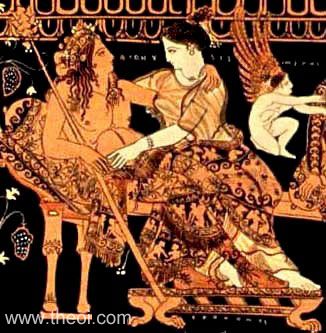
Dionysus/Bacchus absorbed many other deities including Liber and Zagreus. Absorbed or are they different aspects thereof? Anyway, a bit about Ariadne: Her name means "Most Holy" in both Greek and Latin. Quoth Wiki: Ariadne (Etruscan Areatha) is paired with Dionysus (Etruscan Fufluns) on engraved bronze Etruscan bronze mirrorbacks, where the Athenian culture-hero Theseus is absent, and Semele (Etruscan Semla), as mother of Dionysus, may accompany the pair, lending a particularly Etruscan air of family authority.

An inscription from Knossos (home of Ariadne, the infamous labyrinth and Minotaur) says: "to all the gods, honey... to the mistress of the labyrinth honey" Ariadne as Priestess of Knossos? Mistress of the Labyrinth? There are stories associating Dionysus and Proserpina. Is Ariadne another name for her? Certainly, if the labyrinth is the decent into and return from the Underworld, the labyrinth is her domain. Are the two Goddesses the same? Different names from different lands? Is Ariadne the Minoan Snake Goddess Herself? There are also myths involving Dionysus descending into the Underworld to retrieve Ariadne as well as his mother, Semele (Proserpina and Ceres?) It was spoofed in ancient times, by Aristophanes in his comedy, The Frogs. Instead of going to the underworld to get the women back, he complains about a lack of good writers and goes to bring back the best one. There is a contest where he decides. Stephen Sondheim updated the concept in a musical.

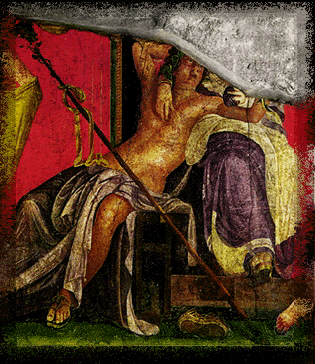
Note the last picture from the Villa of the Mysteries. Is this the Bacchic Cult Rites? Is it the Eleusinian Mysteries? Were they combined in Greece? Are Proserpina and Ariadne alternate names for the same Goddess? Mmmm food for thought, tastes great, less filling.


http://images.travelpod.com/tw_slides/ta00/bba/ce4/minoan-snake-goddess-palaiokhora.jpg


Dionysus & Ariadne at a tragedy play | Greek vase, Athenian red figure volute krater

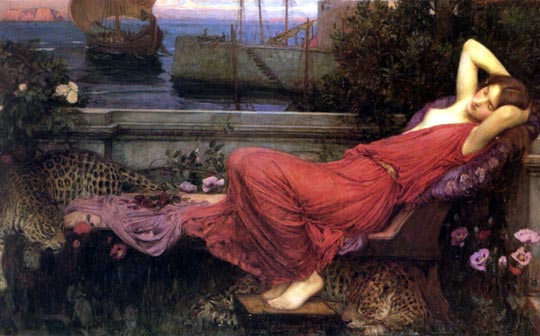
http://www.jwwaterhouse.com/paintings/images/waterhouse_ariadne.jpg
Note the Leopards in this Waterhouse painting. They are associated with Dionysus

Dionysus with Semele or Ariadne?