Showing posts with label Sabine. Show all posts

Wednesday, February 1, 2012

You call it Imbolc. We call it Februarius.

There are so many feasts and festivals upcoming and ongoing depending on the region, especially from pre-Roman times. Today we celebrate the return of Proserpine, or Kore to Her Mother and the upper world. To this day Catholics celebrate by lighting candles to the Queen of Heaven and blessing the candles. Celts celebrate Brigid/Imbolc. The Norse celebrate Freya.

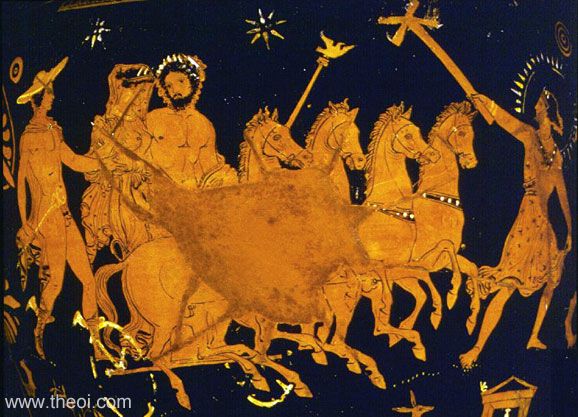
Return of Persephone, with Hades, Hermes & Hecate | Greek vase, Apulian red figure krater
The Return of Persephone
February is named for Februus, a possible Etruscan deity of purification and of the underworld. Perhaps an epithet of or akin to Pluto? I've seen the names Februa and Februatio in my studies as possible Sabine deities. Are they a Sabine divine pair who jointly ascend? The picture above shows Proserpine being returned to the upper world b Pluto and flanked by Hermes and Hecate.

This is the month of purification, of spring cleaning in preparation for the new year. Soon I'll be posting about the Parentalia (the origin of many hallow's eve traditions), Lupercalia and the origins of love day (my annual whip my Roman Sex Gods re-post with additional info!), Februalia, and the Feralia, celebrating the underworld deities (see what I mean about Februa and Februato?).

Whatever name you call this turn of the wheel, I hope you have a happy one!

Wednesday, January 4, 2012

Dea Strenia

This Goddess is viewed as the pre-christian origin of La Befana. Strenia was a Sabine Goddess of strength and endurance. She had a temple on the Via Sacra and was honored at the start of the new year. Emperors would receive gifts at Her temple and the monies collected were used for the upkeep and expansion of the public temples of the Roman state.


From the book Vestiges of Ancient Manners and Customs, Discoverable in Modern Italy and Sicily by Rev. John J. Blunt (John Murray, 1823):
"This Befana appears to be heir at law of a certain heathen goddess called Strenia, who presided over the new-year's gifts, 'Strenae,' from which, indeed, she derived her name. Her presents were of the same description as those of the Befana—figs, dates, and honey. Moreover her solemnities were vigorously opposed by the early Christians on account of their noisy, riotous, and licentious character."
From the book Domestic Life in Palestine, by Mary E. Rogers (Poe & Hitchcock, 1865)::
"An 'Essay on the Fine Arts,' by E. L. Tarbuck, led me to believe that this custom is a relic of pagan worship, and that the word "Bastrina" refers to the offerings which used to be made to the goddess Strenia. We could hardly expect that the pagans who embraced Christianity could altogether abandon their former creeds and customs. Macaulay says, "Christianity conquered paganism, but paganism infected Christianity; the rites of the Pantheon passed into her 'worship, and the subtilties of the Academy into her creed.' Many pagan customs were adopted by the new Church. T. Hope, in his 'Essay on Architecture,' says: 'The Saturnalia were continued in the Carnival, and the festival with offerings to the goddess Strenia was continued in that of the New Year…'"


From The Roman Forum: a topographical study:
"The Roman antiquaries inform us that the term Sacred Way is applicable to a road leading from the Sacellum (chapel) of the Goddess Strenia, in or near the Carinae, to the Capitoline citadel..."
Christmas and epiphany gifts in Italy are still called strenae .  

Here we have a Sabine Goddess (remember il rapimento delle sabine?) who is honored at the start of the year with gifts of sweets and boughs from Her sacred grove and with money. It's not a leap to surmise Her worship was continued as La Befana, or as the personification of La Epifania. 


This Friday I'll be exchanging strenae with Family, making a donation of money in Her name, donating shoes and coats, and sharing the vegan struffles I'm making for the occasion!


Monday, September 5, 2011

Are you worth your salt? (some Adult content alert!)

This phrase comes from the Romans, who paid their soldiers, at least partially, in Salt. The word salary comes from the Latin world salarium, which translates to "payment in salt." The ancient world over, salt was a highly valued commodity, traded on par with gold. The Romans built roads specifically for making the transportation of salt more convenient. One such road, the Via Salaria, led from Rome to the Adriatic sea, where salt was produced by evaporating sea water.

I came across several interesting bits in the book The Etruscans outside Etruria by Paolo Bernardini and Giovannangelo Camporeale. There is speculation in this book that the Etruscans contributed salt to the trade economy for wine in particular.

Salt was another of Etruria's great resources. It was either mined, as in Volterra, or extracted from seawater in evaporation ponds that were set up along the Tyrrhenian coast. Between Ostia and Pisa the location name Saline is often found, a name testifying to an activity that had extremely ancient roots in the area. Indeed, wars between Rome and Veii that date back to the time of Romulus were fought over the possession of saltworks, which were quite productive near the mouth of the Tiber.
The role of salt in the greater economy must not be overlooked, though its traces are mostly hypothetical. Salt would explain the arrival of a substantial quantity of Euboean (Greek) pottery in Veii and Rome during the eighth century; sources date the wars between these two cities over the possession of the saltworks at the mouth of the Tiber to this same period.

Pythagoras was pretty keen on salt too: "Salt is born of the purest parents: the sun and the sea." He also said that "salt was the emblem of justice; for as it preserves all things and prevents corruption, so justice preserves whatever it animates, and without it all is corrupted."

Hippocrates lauded the use of sea water and salt baths for healing, as did texts from ancient China. Ghandi began the non violent revolution against Great Brittain with the Salt March. In short: The Brits controlled salt production and made it illegal for anyone else to produce it, even for themselves. You can read more about this on the holy wiki.

From The folklore of common salt: http://www.sacred-texts.com/etc/mhs/mhs32.htm
In Sicily, too, it is sometimes customary for the priest to place a little salt in the child's mouth at baptism, thereby imparting wisdom. Hence the popular local saying in regard to a person who is dull of understanding, that the priest put but little salt in his mouth. A similar usage is in vogue in the district of Campine in Belgium. The use of salt at baptism in the Christian Church dates from the fourth century. It was an early practice to place salt, which had been previously blessed, in the infant's mouth, to symbolize the counteraction of the sinfulness of its nature.

Here's a Roman folk tale called The Value of Salt

Enough with the history lesson! Let's get to business!

Salt protects. It was used in mummification and in meat production to preserve. So wouldn't it protect metaphysically too? One of the things we look to when we commune with The Horned God is protection. We wear a horn. We flash the mano fico. This highly valued, magical protection powder we are talking about now is white and salty. Have I drawn enough of a picture? No? It's divine spunk. There, I said it. The preserver and protector in mineral form. A man's ejaculate is a reflection of the divine male spark. Salt is the stuff of life. Marry it with the waters of our mother's womb and there we have the primordial ocean from which Love herself, and life sprang forth. Too much?* After my Priapus post you know we don't shy away from these topics here :)

Many magical traditions use salted water representing the union between male and female, the ultimate means of cleansing and preserving all in one. Salt in the corners of the room repels negativity. Salt before your door will negate anyone or thing trying to bring evil into your home.

Aside from constantly tending the fire, the other main job of the Vestal Virgins was to make the Mola Salsa, the salted cake. It was used to purify sacrifices and alternately burned as an offering. I find it interesting that this tradition was introduced by Pompilius, the second King of Rome, who happened to be Sabine. The cakes were less like KFC biscuits and more like, say wafers. Also interesting is the fact that many nunneries used to produce the communion wafers.

The salt and grain was, and is, used to purify a space. In modern times, when moving into a new home, bread and salt are brought in to ensure protection and prosperity.

Don't want someone to return to your home? Put dash of salt in their shoes. Can't get their shoes off surreptitiously? Throw the salt on their tracks as they leave.

Salt can be used to delineate sacred space aka cast a circle.

You can trace sigils in salted water to root protection wards on your body or property or windowsills. Keep some in a small pouch in your car, tied with a red ribbon.

We haven't even gotten into the uses of black salt yet! I'll direct you to  Lucky Mojo who has a whole page on the uses of salt. http://www.luckymojo.com/salt.html

And don't forget: *Take these blog posts with a grain of salt ;)
Friday, January 7, 2011

Ancient Roman Hate-Fuck, huh?

Hubby came up with the title of tonight's post. (It was in reference to a discussion of the show Spartacus: Blood and Sand). I decided I needed to use that as a post title. What subject would possibly fit? It's a bit od a stretch, but who cares: Tonight's topic:

The Rape of the Sabine Women.


Why do they call it that? The actual word is "rapito" which means "kidnapped," not sexually violated. I digress. The story, in brief:

Romulus and Remus founded Rome. Romulus killed his brother Remus (where have we heard that before?) and names the city after himself. He also brought in ex-cons and outlaws to populate the city quickly. Makes for a great army, but not so much a great society when you have no heirs. The Romans needed to populate their city with Women.

They allegedly asked permission to marry from other local tribes but were rebuked. If you saw some big badasses trying to move in on your land, wouldn't you want them to disappear in a generation? The Romans were refused. Using their brains as well as their brawn, The Romans threw a big festival to Neptune and invited everyone to come- what we'd call a "family friendly event" these days. Folks came, especially the local Sabines. While the men were distracted with the games, the Romans kidnapped the women and took off.

By the time the Sabine men were ready to fight, Romulus had already negotiated directly with the women (which they should have done in the first place). He guaranteed them equal civil rights and property rights amongst other things. I wonder if he offered to let them go home if they said no. Anyway, the Sabine men finally get their asses in gear and wage war on the Romans when the Women show up and stop the fight. Livy attributes lovely speeches to the Ladies, something along the lines of "kill me instead, I don't want to live without my father or my husband." The men stop the fighting, the king of the Sabines gets to be co-ruler with Romulus (he died 5 years later... hmmm) and the Sabine families moved to Rome.  This is allegedly where the tradition of carrying the bride over the threshold came from.

Do I believe this actually happened? I have no idea. I think it's true on some level. I think they needed Women to survive, but I don't think a mass kidnapping is too bright, and I don't think it would've been all touchy feely with guaranteed rights, "real" marriages (as wiki reports)... what was the concept of "marriage" in those days anyway? (Is this period technically Roman or still pre-Roman? lol). I think the Romans would have had more resources than just having a bunch of ex cons kidnapping the local maidens. Part of the story that's especially fishy is that the women brought their children to the battle to stop it. Wha? FFS it took YEARS for the fathers, husbands and brothers of the Sabine women to get their shit together to get em back? That's what really sends this into the realm of fable for me.

When I'm in a good mood, I romanticize it- the neighboring women loved the Roman men and the mean Sabine daddies were keeping them apart. Bad mood? The evil men kidnapped the women and forced them to bear their children.


So what does this have to do with anything? Yeah.... I don't know. It something that's come up in my reading lately; I don't mean this specific story, but in general the idea that Rome was the America of the ancient world: Show up, found a city, intermarry with the natives (well, the colonists brought whole families here, but I digress), sections of the territory were ruled by several different far off powers until one group comes in and takes over the whole thing, war with one native tribe after another for a land grab until the natives are killed or assimilated... Sound familiar?

Rome was the melting pot of it's day, no matter if they forced some of the melting or not. I find it fitting that so many Italians immigrated to New York City, including my family.


PS: Anita: This rambling post was for you ;)