Showing posts with label Etruscan. Show all posts

Wednesday, February 1, 2012

You call it Imbolc. We call it Februarius.

There are so many feasts and festivals upcoming and ongoing depending on the region, especially from pre-Roman times. Today we celebrate the return of Proserpine, or Kore to Her Mother and the upper world. To this day Catholics celebrate by lighting candles to the Queen of Heaven and blessing the candles. Celts celebrate Brigid/Imbolc. The Norse celebrate Freya.

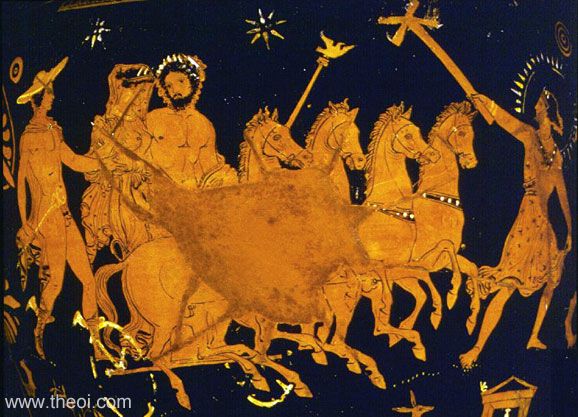
Return of Persephone, with Hades, Hermes & Hecate | Greek vase, Apulian red figure krater
The Return of Persephone
February is named for Februus, a possible Etruscan deity of purification and of the underworld. Perhaps an epithet of or akin to Pluto? I've seen the names Februa and Februatio in my studies as possible Sabine deities. Are they a Sabine divine pair who jointly ascend? The picture above shows Proserpine being returned to the upper world b Pluto and flanked by Hermes and Hecate.

This is the month of purification, of spring cleaning in preparation for the new year. Soon I'll be posting about the Parentalia (the origin of many hallow's eve traditions), Lupercalia and the origins of love day (my annual whip my Roman Sex Gods re-post with additional info!), Februalia, and the Feralia, celebrating the underworld deities (see what I mean about Februa and Februato?).

Whatever name you call this turn of the wheel, I hope you have a happy one!

Tuesday, November 29, 2011

Migration Patterns

No one knows better than a bird of the air where treasures are concealed.
- Aristophanes The Birds


I'm not a bird watcher, I can't pick out rare birds at a hundred yards, but I know the basics. I can spot a finch, a blue jay, a cardinal, a sparrow, a woodpecker, crows, and my special friends, hawks.

In Etruscan Magic, Leland wrote about birds in regard to finding treasure and in Aristophanes' The Birds, the scene opens up with two characters each carrying a bird to point the way to go. Etruscan augurium ex avium was concerned with the sounds birds made as well as the number of birds and the pattern of their flight.

We have some records of the Roman practice of Augury. We can only wonder if it was imported entirely from the Etruscans, or changed to suit the Romans, or both.

Something interesting from the holy wiki:
The lituus was a crooked wand (similar in shape to the top part of a crosier) used as a cult instrument in ancient Roman religion by augurs to mark out a ritual space in the sky (a templum). The passage of birds through this templum indicated divine favor or disfavor for a given undertaking.
A templum was the sacred space defined by an augur for ritual purposes, a place "cut off" as sacred. It could be created as temporary or permanent, depending on the lawful purpose of the inauguration. Auspices and senate meetings were unlawful unless held in a templum; if the senate house (Curia) was unavailable, an augur could apply the appropriate religious formulae to provide a lawful alternative.
To create a templum, the augur aligned his zone of observation (auguraculum, a square, portable surround) with the cardinal points of heaven and earth. The altar and entrance were sited on the east-west axis: the sacrificer faced east. The precinct was thus "defined and freed" (effatum et liberatum).
In most cases, signs to the augur's left (north) showed divine approval and signs to his right (south), disapproval. Stone-built temples followed this ground-plan and were sacred in perpetuity.

I've been quite taken with the pattern of bird flight lately. Look up, they'll let you know what's going on. I'm a believer in personal symbolism when it comes to divination be it tarot, tea leaves, pendulum or bird flight patterns: If you think a rose is a good omen, then it's a sign of good omen if it comes up in a tarot spread or in the formation of the tea leaves, or in the pattern of the birds.

If you take the time to center, you can see what the birds are telling us, and hear it too.

What does the pattern look like?
What is the sound? The rhythm?
Who is the bird sacred to?
Where in the sky?
Which direction are they traveling?

It's a big difference in meaning to have sparrows fly in a certain pattern or to have hawks fly in that pattern!

This is not only employed with flocks of birds, but also with single birds you might encounter through the day. I've often had birds chime in at different points in rituals when celebrating outside. This is the kind of this children learn at their parent's and grandparent's knee. It's typically a see and do process, not a lecture and private practice.


To start is easy, especially if you have any kind of background in divination and/or meditation:

Breathe, tune in to your blood flow, listen, look, receive, record

May your bird watching be auspicious!

Saturday, November 12, 2011

More calendrical bullshit

Way too many people have been talking about 11/11/11. Facebook has been effing flooded with hippie fluffy crystal bunny new age run amok namby-pamby fluffernutter hooey. Yep, it's rant night. The Etruscans and Romans had their market days, and I have my rant nights.

I don't understand the appeal. Hubby calls it odometer mentality. It's nice to see the numbers roll around and be all symmetrical and what-not. Hmm I disagree with hubby- it's not "odometer mentality." It's Jackpot mentality! Hate to have to be the one to tell you this:

You don't automatically win something just because some numbers matched up!


I've posted here many times on the calendar fuckery from different societies and different cultures and who imposed what on whom. So this is 11/11/11 in the current era Gregorian Calendar which everyone uses so the world can do business. Fanfrickintastic. However, this is not the first calendar, nor is it the last calendar. Nor is it the only calendar.

Today is also 14 Cheshvan, 5772. 
The Assyrian calendar is up to 6761.
It's 12011 in the Holocene calendar, dating from the start of the Human Era.
The Berber calendar is nearly at 3k. Will people go batshit crazy on 03/03/3000? Not likely.

The only thing special about this day is the attention being given to it. Sounds like Snooki. If you can elevate this date in your mind, why not any date? Why not wake up and decide you are more powerful now? Why not cloak yourself in power and become who and what you wish to be? Sounds a little Secret-New-Agey, but the principle is true. You have the ability to take your power up to the next level, you just need the motivation to do it. If you want to call down the choirs of Angels on a special date, or make this the first day of the rest of your life, or step through a new doorway of power and knowledge, then do it. There's no need for you to wait for some magical man-made calendar number to pop up.

Each day is unique! Each moment is unique! You can embrace this at any time. Let me rephrase this: You can embrace any time. Find its special, unique qualities and work with them. You don't need an excuse like a random pretty looking number. Just get to it!

Sunday, November 6, 2011

Private vs Public

Last week was the very public celebration of Hallows Eve. However, it wasn't the astrologically correct celebrations of Hallows. That happens just after midnight on Tuesday when the sun reaches 15 degrees Scorpio. It coincides with the opening of the Mundus, an act which was allegedly adopted from the Etruscans wherein the portal to the underworld is opened and the spirits of the dead are allowed to roam for a time and food along with other offerings are tossed into the pit as an offering to the spirits of the departed and of the land.

With all of the hullabaloo last week, I wasn't able to do anything grand, as I am wont to do, so I will be out in my Grove tomorrow night working the work. Something to keep in mind, as one of my compatriots reminded me, is that most festivals lasted for day. I also wanted to add that there were both public and private aspects to most festivals. Duty was done in the home, on the private land, in the town center, in the temple and in whichever place was sacred to the deities or spirits involved in the celebration. My obligation to the public face of this holiday has been fulfilled and now it is time to fulfill my obligation at home.

From our Nova Roma friends:

Gate to the underworld
One such stone covered the mundus Cereris, a pit thought to contain an entrance to the underworld. Most cities of Latium and Etruria contained a similar pit or ditch; Plutarch describes the custom of a mundus as being of Etruscan origin, and states that it was used as a place where first-fruits were deposited.

The Latin word mundus simply meant "world".  Festus, quoting Cato this time, explains that:
Mundo nomen impositum est ab eo mundo qui supra nos est.(The mundus gets its name from that world which is above us.)

The Roman mundus was located in the Comitium , on the Palatine Hill. This stone was ceremonially opened three times a year, during which spirits of the blessed dead (the Manes) were able to commune with the living. The three days upon which the mundus was opened were August 24, October 5, and November 8. Fruits of the harvest were offered to the dead at this time.

"When the mundus is open, it is as if a door stands open for the sorrowful gods of the underworld. -Varro

Check out this cable published in the NY Times nearly 100 years ago! 


My feast will conclude on Thursday with the full moon. Then on Friday we'll turn our attention to the winter holidays and the week of decorating! Until then my halls will continue to be decked with black, purple, orange, pumpkins, ghosts, masks and other accoutrement of this hallowed holiday.

Upcoming topics: Daylight savings, Magic of the Renaissance, and, suggested indirectly by a paisan: "Who was the first one to look at an artichoke and decide that it would be a tasty treat?" Yeah!

Friday, October 21, 2011

Venusian

It's Friday here and I've realized that I have not given enough love to Love Herself, Venus. On my recent trip to the Met I perused the Cyprus collection and really paid attention to the Venus statues and votives there, as well as the ones in the rest of the collections.

So here's an offering to Venus, my Libra patron, in the words of Sappho:


A Hymn to Venus
by: Sappho (c. 610-570 B.C.)
translated by Ambrose Philips

O Venus, beauty of the skies,
To whom a thousand temples rise,
Gaily false in gentle smiles,
Full of love-perplexing wiles;
O goddess, from my heart remove
The wasting cares and pains of love.

If ever thou hast kindly heard
A song in soft distress preferred,
Propitious to my tuneful vow,
A gentle goddess, hear me now.
Descend, thou bright immortal guest,
In all thy radiant charms confessed.

Thou once didst leave almighty Jove
And all the golden roofs above:
The car thy wanton sparrows drew,
Hovering in air they lightly flew;
As to my bower they winged their way
I saw their quivering pinions play.

The birds dismissed (while you remain)
Bore back their empty car again:
Then you, with looks divinely mild,
In every heavenly feature smiled,
And asked what new complaints I made,
And why I called you to my aid?

What frenzy in my bosom raged,
And by what cure to be assuaged?
What gentle youth I would allure,
Whom in my artful toils secure?
Who does thy tender heart subdue,
Tell me, my Sappho, tell me who?

Though now he shuns thy longing arms,
He soon shall court thy slighted charms;
Though now thy offerings he despise,
He soon to thee shall sacrifice;
Though now he freezes, he soon shall burn,
And be thy victim in his turn.

Celestial visitant, once more
Thy needful presence I implore.
In pity come, and ease my grief,
Bring my distempered soul relief,
Favour thy suppliant's hidden fires,
And give me all my heart desires.


I feel her more, I think, as The Lady of Roses. Interesting that Etruscan Turan, who syncretizes with Venus, is Goddess of gardens, among other things. I've never been the greenest thumb, but I did plant roses for Her this past summer. Let's see how they fare in the spring!

Thursday, October 20, 2011

Etruscan Birth Goddess?!?

A few friends shared an article today about a recent find from an archaeological dig in Italy. The piece of pottery found is unique because it is from an Etruscan site which was a residence, a home, not a burial chamber, and depicts a woman giving birth. It also dates to 600 BCE. Totally worth the read! Highlights:


Poggio Colla is one of the few sites offering insight of the Etruscan life in a non-funerary context. It spans most of Etruscan history, being occupied from the seventh to the second century B.C.
Centering on the acropolis, a roughly rectangular plateau, the site was also home to a sanctuary: numerous votive deposits indicate that for some part of its history, it was a sacred spot to a divinity or divinities.
The abundance of weaving tools and a stunning deposit of gold jewelry discovered in previous excavations, have suggested that the patron divinity may have been female.

In this view, the ancient depiction of childbirth becomes even more interesting, according to Greg Warden, professor and associate dean for academic affairs at the Meadows School of the Arts at SMU and a director of the Mugello Valley Archaeological Project.


"Might it have some connection to the cult, to the kind of worship that went on at the hilltop sanctuary?," Warden wondered.
Perkins speculated that the woman giving birth could be a representation of an Etruscan goddess, suggesting that Poggio Colla was the location of a cult-site for an Etruscan fertility goddess.
"She would represent a new Etruscan myth, as we know of no Etruscan goddess who gives birth in Etruscan mythology," Perkins said.

A few observations:

Of course they haven't found representations of women giving birth at burial sites. Those sites were set up as houses for the dead supplied with things as if they were still living. Very pyramid-like.

This doesn't necessarily imply an unknown Goddess. The shard could be from a votive piece, buried at the site of the temple asking for a healthy birth.

We know little of Etruscan lore, but what is out there labels Uni the Mother Goddess and the one to petition for Fertility. She is syncretized with Juno, aka Iuno. Iuno... Uni... Hmmm... Also, like Iuno/Hera, Uni is related to the hero the Romans call Heracles and alleged to be his Mother, not his step-mother. There is art depicting the relationship too.  So yeah, we might know of an Etruscan Goddess who gives birth ;)

Here's an interesting article on Uni, tho nothing is cited.

A link within the article above leads to a story from 2010 about the discovery of an Etruscan home, not a burial site. Also, religious sites have been discovered, including temples. Looks like the Etruscans are revealing their whereabouts as well!

Tuesday, September 13, 2011

Ludi Romani

Another effing festival? Seriously? Yeah. The Romans liked their festivals. They had so many because they also liked the festivals of the deities they co-opted from the regions they conquered and assimilated.

The Ludi Romani was the biggest festival in Rome. Sources debate the origin date, but it's ballparked around the 5th century BCE. Allegedly it started out as a quickie festival, only on the Ides of September, but with an influx of cash, the festival grew larger. Some sources claim they were held annually, others claim they were sporadic for a time but eventually became an annual event.

There were chariot races and plays and concerts and gladiatorial contests and feasts and sacrifices. Actually, I stated all of that backwards: The festival started with a procession to the temple of Jupiter where a cow was sacrificed. I've also read that the procession went from the temple to the Circus Maximus. Its likely both are correct: The festival evolved over the years in length and entertainments presented. During this festival was the Epulum Jovis, a banquet where the statues of Jupiter, Juno and Minerva, the Capitoline Triad, were adorned and sat at the table with those feasting. They were served the food on the dishes and their priests were their, as one site put it, "gastronomic proxies."

This site has some nifty information as well as the picture of a coin which shows what the Temple probably looked like.

What I can't find is the end date for the Ludi Romani. When were they no longer celebrated? Or are they still celebrated in some form? 

Aside from the historical stuff you can look up on wiki as easily as I can, what I want to focus on a bit is the legend of how the games began: Tarquinus Priscus, later known as Tarquinus the Elder, was the 5th King of Rome. However, he was from Etruria. Legend has it that he was denied political office in Etruria because his father was a Greek immigrant, so he went to Rome to find his fortune. That he did! Further, the legend tells of an eagle swiping his cap when he entered the city and placed it back on his head. I wonder who started that one! He became friends with the 4th King and when his friend passed, Tarquinus talked the senate into declaring him King. Apparently it worked. The Ludi Romani were allegedly started in honor of Tarquin's winning a military victory, which one is debated. He created the Circus Maximus for chariot races.

Little remains of the Circus Maximus, but from the evidence we have, it was effing fabulous! Biggest. Arena. Ever. I've come across a site which claims the last games held at the Circus Maximus, not specifically the Ludi Romani, were in 549 CE. A thousand years of games. Today? Pft. They knocked down and rebuilt Giant Stadium AND Yankee Stadium in the past few years. Take a gander here, and you'll be able to see what's left, which is barely the footprint.

Circus Maximus depicted on the back of a coin

So now the question is, why oh why was Rome partying while everyone else in Italy was bringing in the last harvest and preparing for winter? The games were free to all, but was this just a festival for the wealthy? More tomorrow, perhaps on what the rest of Italia was up to in September!

Monday, September 5, 2011

Are you worth your salt? (some Adult content alert!)

This phrase comes from the Romans, who paid their soldiers, at least partially, in Salt. The word salary comes from the Latin world salarium, which translates to "payment in salt." The ancient world over, salt was a highly valued commodity, traded on par with gold. The Romans built roads specifically for making the transportation of salt more convenient. One such road, the Via Salaria, led from Rome to the Adriatic sea, where salt was produced by evaporating sea water.

I came across several interesting bits in the book The Etruscans outside Etruria by Paolo Bernardini and Giovannangelo Camporeale. There is speculation in this book that the Etruscans contributed salt to the trade economy for wine in particular.

Salt was another of Etruria's great resources. It was either mined, as in Volterra, or extracted from seawater in evaporation ponds that were set up along the Tyrrhenian coast. Between Ostia and Pisa the location name Saline is often found, a name testifying to an activity that had extremely ancient roots in the area. Indeed, wars between Rome and Veii that date back to the time of Romulus were fought over the possession of saltworks, which were quite productive near the mouth of the Tiber.
The role of salt in the greater economy must not be overlooked, though its traces are mostly hypothetical. Salt would explain the arrival of a substantial quantity of Euboean (Greek) pottery in Veii and Rome during the eighth century; sources date the wars between these two cities over the possession of the saltworks at the mouth of the Tiber to this same period.

Pythagoras was pretty keen on salt too: "Salt is born of the purest parents: the sun and the sea." He also said that "salt was the emblem of justice; for as it preserves all things and prevents corruption, so justice preserves whatever it animates, and without it all is corrupted."

Hippocrates lauded the use of sea water and salt baths for healing, as did texts from ancient China. Ghandi began the non violent revolution against Great Brittain with the Salt March. In short: The Brits controlled salt production and made it illegal for anyone else to produce it, even for themselves. You can read more about this on the holy wiki.

From The folklore of common salt: http://www.sacred-texts.com/etc/mhs/mhs32.htm
In Sicily, too, it is sometimes customary for the priest to place a little salt in the child's mouth at baptism, thereby imparting wisdom. Hence the popular local saying in regard to a person who is dull of understanding, that the priest put but little salt in his mouth. A similar usage is in vogue in the district of Campine in Belgium. The use of salt at baptism in the Christian Church dates from the fourth century. It was an early practice to place salt, which had been previously blessed, in the infant's mouth, to symbolize the counteraction of the sinfulness of its nature.

Here's a Roman folk tale called The Value of Salt

Enough with the history lesson! Let's get to business!

Salt protects. It was used in mummification and in meat production to preserve. So wouldn't it protect metaphysically too? One of the things we look to when we commune with The Horned God is protection. We wear a horn. We flash the mano fico. This highly valued, magical protection powder we are talking about now is white and salty. Have I drawn enough of a picture? No? It's divine spunk. There, I said it. The preserver and protector in mineral form. A man's ejaculate is a reflection of the divine male spark. Salt is the stuff of life. Marry it with the waters of our mother's womb and there we have the primordial ocean from which Love herself, and life sprang forth. Too much?* After my Priapus post you know we don't shy away from these topics here :)

Many magical traditions use salted water representing the union between male and female, the ultimate means of cleansing and preserving all in one. Salt in the corners of the room repels negativity. Salt before your door will negate anyone or thing trying to bring evil into your home.

Aside from constantly tending the fire, the other main job of the Vestal Virgins was to make the Mola Salsa, the salted cake. It was used to purify sacrifices and alternately burned as an offering. I find it interesting that this tradition was introduced by Pompilius, the second King of Rome, who happened to be Sabine. The cakes were less like KFC biscuits and more like, say wafers. Also interesting is the fact that many nunneries used to produce the communion wafers.

The salt and grain was, and is, used to purify a space. In modern times, when moving into a new home, bread and salt are brought in to ensure protection and prosperity.

Don't want someone to return to your home? Put dash of salt in their shoes. Can't get their shoes off surreptitiously? Throw the salt on their tracks as they leave.

Salt can be used to delineate sacred space aka cast a circle.

You can trace sigils in salted water to root protection wards on your body or property or windowsills. Keep some in a small pouch in your car, tied with a red ribbon.

We haven't even gotten into the uses of black salt yet! I'll direct you to  Lucky Mojo who has a whole page on the uses of salt. http://www.luckymojo.com/salt.html

And don't forget: *Take these blog posts with a grain of salt ;)

Wednesday, August 24, 2011

The Earth done quaketh!

I've always loved this Lewis Black line, but today... not so funny. Colorado in the morning and most of the eastern seaboard in the afternoon! NYC was shaking! WTF!?!

Time to show some love and appreciation for Neptune, the Earth shaker! His domain is more than the sea, it's the crust of the earth itself which lies beneath the seas. I'm posting several different hymns to Him below. I say we start paying attention now and skip the overturned-plastic-chair-ha-ha-look-at-the-"destruction"-neener-neener meme.

Let's also give a nod to Nethuns, the Etruscan (Latin?) predecessor of Neptune. According to various sources, he was originally a God of wells and later came to rule all water. He has much in common with Poseidon and Neptune including the trident, the anchor, the sea horse, and the dolphin. (Thanks to pantheon.org!) According to Cities and Cemeteries of Etruria:
Neptune is of rare occurrence in Etruscan monuments, which is singular, considering the maritime character of the people. The name "Nethuns" occurs on a mirror in the Gregorian Museum (Vol. II. p520). Gerhard (Gottheit. pp2, 19) regards this as the Latin name, and doubts if Neptune were an Etruscan deity, though he is said to have been one of the Penates (Arnob. adv. Nat. III.40; Serv. ad Aen. II.325), but Müller (III.3, 4) says justly, if the name be not Etruscan, that people must have had a god of the sea.


XVI. To Neptune
The Fumigation from Myrrh
Hear, Neptune [Poseidon], ruler of the sea profound,
whose liquid grasp begirts the solid ground;
Who, at the bottom of the stormy main,
dark and deep-bosom'd, hold'st thy wat'ry reign;
Thy awful hand the brazen trident bears,
and ocean's utmost bound, thy will reveres:
Thee I invoke, whose steeds the foam divide,
from whose dark locks the briny waters glide;
Whose voice loud founding thro' the roaring deep,
drives all its billows, in a raging heap;
When fiercely riding thro' the boiling sea,
thy hoarse command the trembling waves obey.
Earth shaking, dark-hair'd God,
the liquid plains (the third division) Fate to thee ordains,
'Tis thine, cærulian dæmon, to survey well pleas'd the monsters of the ocean play,
Confirm earth's basis, and with prosp'rous gales waft ships along, and swell the spacious sails;
Add gentle Peace, and fair-hair'd Health beside,
and pour abundance in a blameless tide.


To Poseidon
I begin to sing about Poseidon, the Great God, mover of the earth and fruitless sea,
God of the deep who is also lord of Helicon and wide Aegae.
A two-fold office the gods allotted you, O Shaker of the Earth,
to be a tamer of horses and a saviour of ships!
Hail, Poseidon, Holder of the Earth, dark-haired lord!
O blessed one, be kindly in heart and help those who voyage in ships!


Here is a poem written by Arion, who was rescued by a dolphin. He wrote this in thanks and praise of Neptune:

Highest of the Gods, Lord of the sea,
Poseidon of the golden trident, earth-shaker in the swelling brine, a
round thee the finny monsters (theres) in a ring swim and dance,
with nimble flingings of their feet leaping lightly, snub-nosed hounds with bristling neck, swift runners, music-loving dolphins, sea-nurslings of the Nereis (Nereid) maids divine, whom Amphitrite bore,
even they that carried me, a wanderer on the Sikelian (Sicilian) main, to the headland of Tainarion (Taenarum) in Pelops' land,mounting me upon their humped backs as they clove the furrow of Nereus' plain, a path untrodden, when deceitful men had cast me from their sea-faring hollow ship in to the purple swell of sea.

Finally, a hymn written during the late 1500s or early 1600s by Thomas Campion:

A Hymn in Praise of Neptune

Of Neptune's empire let us sing,
At whose command the waves obey;
To whom the rivers tribute pay,
Down the high mountains sliding:
To whom the scaly nation yields
Homage for the crystal fields
   Wherein they dwell:
And every sea-dog pays a gem
Yearly out of his wat'ry cell
To deck great Neptune's diadem.

The Tritons dancing in a ring
Before his palace gates do make
The water with their echoes quake,
Like the great thunder sounding:
The sea-nymphs chant their accents shrill,
And the sirens, taught to kill
   With their sweet voice,
Make ev'ry echoing rock reply
Unto their gentle murmuring noise
The praise of Neptune's empery.
Sunday, July 17, 2011

Trance/Possession/Prophecy

Today was the Janet Farrar and Gavin Bone workshop on Trance-Prophecy. It was very interesting. I've used tarantella and pizzica as trance inductors and also Drawing Down the Moon, which is Italian, by the way. Etruscan, if you want to get specific about it. I was surprised that they've done work in Italy, but I guess I shouldn't be.

I volunteered to let Gavin take me down the path and let myself be possessed. I decided to trust him and let go of my ego and my own way of doing things. In a meditation earlier in the day, I saw Diana walking in front of me down the path, so when I volunteered, I suspected it would be Her. It was, and she didn't want to wait for Gavin to get through the entire pathworking. She started coming through me and he told me to pull back and wait, to have more control. She and I were confused, not understanding why we couldn't do this right away. Since I had put my trust in him as my guide, I said let's do it his way, and we did. I can see how it opened up more choice for me. I could have picked any of several who wanted to come through. Diana, however, was most present. She came through, and as he described, it was like relaxing into a warm bath. Everything sounded "underwater" to me. I didn't have a care. I was completely relaxed. When I came back up, it was like a dream that was floating away.  Funny, I had to let go of my hard-won control to gain some.

I do remember that she told the group to "Find the joy in the Work." It's not all dark n mysterious all the time. There is Joy here too. Otherwise, why bother?

There was a ritual for Dionysus afterward in the vineyard. One of my favorite cohorts got to bring Hecate through and rocked it like a Trance-Diva! Part of the ritual was ecstatic dance. I had my tamburello with me and played for both the ritual and the dance. I decided that i wanted to let go and trance MY way, just to feel the back to back comparison. I gave the tamburello to a friend and started dancing and rocking and I handed off my laurel wreath and then as I danced i threw my scarf around someone's neck (like pulling them towards me). Next thing I know I'm on the floor with Gavin's hands on my head telling me to close my chakras LOL

It was a great day. I got to meet some fabulous people learn new techniques, and had a wonderful time. If you get a chance to take this workshop, you should!

Thursday, June 23, 2011

Milestones!

Woooooah.... we're halfway there...

Ack- Bon Jovi is stuck in my head! And likely now in yours too! I mean to post this the other night, but I got off on a tear about something or other, as usual, and didn't even mention it: I've blogged every day for half of the year. That went by really fast! I know not every post is a "winner" but that's not the point of blogging daily for a year. I don't know how I feel about this milestone, so I'll talk about literal ones:

The Golden Milestone and the Mundus, or the Navel of Rome, have been conflated and conflicted for ages. No one can agree on if they were related or the golden one was just a fancy version dedicated by Augustus Caesar. The Golden Milestone was the zero marker from which all distance to other cities was measured.

In reading about both and their relationship to each other, I came across this section of a book, Historical Tales: The Romance of Reality from 1896. (Seriously, one day I need to look up what major planetary aspects were going on in the 1890's because so many books about ancient Italy were written in that time frame). This is interesting, at least to me, because it's not just about the founding of Rome, but how it was consecrated, and how he went to the Etruscans to learn how to do it!

Far back in time as it was when this took place, Italy seems to have already possessed numerous cities, many of which were to become enemies of Rome in later days. The most civilized of the Italian peoples were the Etruscans, a nation dwelling north of the Tiber, and whose many cities displayed a higher degree of civilization than those around them. From these the Romans in later days borrowed many of their religious customs, and to them Romulus sent to learn what were the proper ceremonies to use in founding a city.
The ceremonies he used were the following. At the centre of the chosen area he dug a circular pit through the soil to the hard clay beneath, and cast into this, with solemn observances, some of the first fruits of the season. Each of his men also threw in a handful of earth brought from his native land. Then the pit was filled up, an altar erected upon it, and a fire kindled on the altar. In this way was the city consecrated to the gods.

Having just consecrated my own piece of land to a specific purpose, I thought the timing was fitting. I know this is likely just a story and there is no specific evidence supporting the idea that Romulus went to the Etruscans to learn how to consecrate his city (and no reason why they would help him to do this...). I thought it was an interesting idea. More tomorrow!

Tuesday, January 18, 2011

Exploring Etruria

I've been talking a lot about Sicily, but tonight I'm in the mood to pay some attention to another thread of my lineage, my Grandmother's side; That part of my family lived in what was once the southernmost part of Etruria, Naples. The name of the city is interesting. It's from the Greek, Neapoli, meaning New City. The Greeks founded the colony after the Etruscans were too weak to hold it any longer. Modern natives of the city still call themselves by the prehellenic name, Parthenopians, for the city of Parthenope. Wha? Parthenope was one of the Sirens from The Odyssey. She was so distraught that she was unable to entice Odysseus that she threw herself into the sea and her body washed up on the shore of the city, which took her name. There's even a bust of the siren, Parthenope in Naples.
 
I've always just plain known Greek lore. Later, when I was exposed to it, I felt the same way about the Etruscans. Maybe this is why I'm such a Shakespeare buff: He wrote about Greece and Rome, after all, and Etruscans too. I recall a trip with hubby to Penn's museum to view an Etruscan art collection many years ago. I found myself staring at one of the mosaics of a woman, riveted by the familiar pattern of her hair: It looked exactly like mine when I have it loosely pulled back. My fellow curly-girls will understand. When brushed back gently and held in place, my hair looks like waves on the ocean. It was a moment when I truly felt connected to my ancestors in more than theory, or as an amorphous energy I could tap into. Seeing the small things like jewelry, coins, mirrors, household objects, that mosaic... It felt like when we cleared out my Aunt's home after she died: Small snapshots of a person's life which help you to better understand who they were. A real person who led a life not that much unlike my own. This whole post might sound silly, and I am pretty tired tonight (almost posted some Aeneid quotes :P), so maybe I'm not quite able to express the awe and wonder I felt that day to truly Know and internalize something I'd always kinda got in theory. Anyway, on to the practical:

My Grandmother knew how to read the animals. This went far beyond the groundhog seeing its shadow. She could tell the weather by what our cat would do. The next day's temperature was predicted from the color of the sunset. Birds of different types and different singing styles noted at different times of day could yield all sorts if information, as did the appearance of spiders, whom everyone was forbidden to kill -this is also a rule in my house too. I've done a bit of reading on Native American animal lore and it's very different, not just because there are different animals involved, but the whole philosophy. There wasn't really any identifying with a particular animal, they just provide the information. My Grandmother was an Augur, she just didn't know the word for it.

So why don't you kill spiders? In short, they're an omen of prosperity. Killing one will bring rain, both literal as well as wet stuff on your head. Speaking of Spiders, I will be posting about the Tarantella in February.  So what's the post-to-do-list count up to now? I have about 20 listed, I think. Let's set a February angenda: Februus, Parentalia, Whip my Roman Sex Gods/Lupercalia, Black Madonna, Tarantella, Hexing as a necessary art, cleansing spells , Diana as a local Deity syncretized by Rome, Carthage/Dido. There. A plan with plenty of room to just go with what's on my mind at the moment or share something inspired by the day's reading. I'll also take questions if anybody posts one.