Showing posts with label Sumeria. Show all posts

Thursday, December 8, 2011

Father Time

Father Time, celebrated even today at the New Year, is known by many names, including Saturn, hence the Roman winter celebration of Saturnalia where the "former" leader of the previous pantheon is honored. In Rome, his statue was bound for the entire year except on His festival.

Why was he bound? Symbolically stopping the passage of time and decay? Because he was of the old pantheon and had to be bound lest he seek revenge on his children who dethroned him? Saturn had done the same to his own father, Ouranos.


How interesting that a new religion took over yet kept the main festival celebration of the old religion. History does repeat itself.
In Roman mythology when Jupiter ascended the throne, Saturn fled to Rome and established the Golden Age, a time of perfect peace and harmony, which lasted as long as he reigned. In memory of the Golden Age, the Feast of Saturnalia was held every year in the winter at the Winter Solstice. During this time no war could be declared, slaves and masters ate at the same table, executions were postponed and it was a season for giving gifts. This was a time of total abandon and merry making. It refreshed the idea of equality, of a time when all men were on the same level. Christians adopted the feast and renamed it Christmas. When the festival ended, the tax collectors appeared and all money owed out to government, landlords, or debtors had to be accounted for. This is another side to Saturn and it's ruling sign, Capricorn: the settling of accounts.
Saturn was once seen as a God of agriculture and fertility- the one who planted and protected the seed. He is also syncretized with one of the oldest recorded Sumerian deities, Ninib, or Ninurta, another farming/fertile deity.


This came up for me today because of my current theatre gig: I am the keeper of time. I set the arrival time, I keep everyone aware of the time by calling it out every 5 minutes for the half hour before we begin. I time the show. I call the breaks and time them as well.


This has taken my meditations to the idea that a cast circle is a time outside of time. Very true. I've been on epic journeys which took days, yet picked up the flow of normal time just minutes later. Time is variable and flexible and in the eye of the beholder- We waste it when we don't have an immediate need for it, yet when we need it we never have enough of it! We're on the clock or off the clock, it flies, it drags... Is Saturn time itself personified?


As for my meditations on the blog today, I'm out of time for blogging and need to be on the clock in a flash! Today I'll leave off with a quick hymn to Father Time, asking for his patronage!


Saturday, November 26, 2011

A huge load of Bull!

No, really... actual bull.The bull is involved in nearly every ancient religion:


Marduk is the "bull of Utu."
Inanna, she sends the Bull of Heaven to wreak havok on Gilgamesh's city.
Ereshkigal is wed to Gulugana, also refered to as the Bull of Heaven
In Hinduism, Shiva rides on a bull
Bull leaping was thought to be part of Minoan culture- Their bull imagery is plainly obvious without even having to mention the Minotaur!
The Hitites had two bulls, Seri and Hurru (day and night) who pulled the godof weather along on his chariot.
Hercules' 7th labor: Capture the Cretan Bull which was wreaking havoc on the island? 
Pliny recorded Druid ceremonies where two bulls were sacrificed
Oxen were sacrificed to Hecate and in the Orphic Hymn, she is referred to as "Tauropolos" or "herder of bulls." Might this by a euphemism in relation to deities associated with bulls? Does she control virility and fertility?


Dionysus was also associated with Bulls and invoked as one by his followers:
The god is invoked by his devotees as a raging bull and a panther, both creatures of ferocious strength and aggressiveness. In hymns Dionysos is addressed as 'the thunderer' and 'the roaring one.' The bull is one of the most frequently mentioned epiphanies of Dionysos; he was considered to be a bull-god, as were Zeus and Poseidon. The bull is a widespread and unequivocal symbol of male strength, potency and virility, particularly in the cultures of India, the near east, and the Mediterranean.


The holy wiki tells us a bit about Egypt's bull worship:


In Egypt, the bull was worshiped as Apis, the embodiment of Ptah and later of Osiris. A long series of ritually perfect bulls were identified by the god's priests, housed in the temple for their lifetime, then embalmed and encased in a giant sarcophagus. A long sequence of monolithic stone sarcophagi were housed in the Serapeum, and were rediscovered by Auguste Mariette at Saqqara in 1851. The bull was also worshiped as Mnewer, the embodiment of Atum-Ra, in Heliopolis. Ka in Egyptian is both a religious concept of life-force/power and the word for bull.
Here's a more in-depth link summarizing different bull cults in Egypt! And yet another!


The Tauropolia was a festival held in honor of Artemis! Here is a coin depicting Her riding a bull.


And the Titan of the moon, Selene was associated with the bull as well: "Selene knows not how to put mules to her yokestrap--she drives a team of bulls!" She's also described in the Orphic hymn as "bull-horned, and wandering through the gloom of night." 


And let's not forget The Golden Calf! Perhaps we know why that was picked as an image to represent the antithesis of the religions of the bible: Mithras slaying a bull is one of the main images of his cult. He also rides bulls as well. 


From 160 CE the Roman cult to Magna Mater included a bull sacrifice known as the taurobolium. Initiates supposedly took their place in a pit beneath a slatted wooden floor, to be drenched by the blood of a bull sacrifice above. This, if an accurate description, is an exception to the usual Roman rules of sacrifice. A lesser version of the rite, known as a criobolium, involved the sacrifice of a ram. The first recorded taurobolium took place at Puteoli in AD 134 in honour of Venus Caelestia.


Frazer talks a bit about this in The Golden Bough, but as has been noted, much of the description of the actual ceremonies comes from possibly hostile christian sources. 


It goes on and on! This surely deserves at the very least a part two, if not a more in depth exploration of the taurean aspect of each of these deities! If this is food for thought, tonight is merely an appetizer. 


Friday, November 25, 2011

Gifties

This is the weekend where many do their holiday shopping, so I thought we should kick off the holiday season here with one fine, Italian example of how every current "christmas" tradition is a repackaged Pagan tradition. Yes, I get immense pleasure out of bursting people's bubble, but only when they're obnoxious in their ignorance. Not like I'm gonna go up to a kid and tell em Santa doesn't exist! He does, they just changed his name ;)

Traditional gifts included wax taper candles, oil lamps, terracotta figurines, and silver.

I wouldn't mind any of the above! Tho if you do shop for me, please keep it local! ;)

I've been reading about more than Roman practices this year- I'm about as familiar with Saturnalia as I can be. What I've been learning more about is the ancient Sumerian practices and festivals surrounding the transition to winter and from old year to new year. This includes the role of Marduk, the festival of Zagmuk, and the ongoing battle with the forces of chaos who, at winter, eat the sun. Omnom.

From Eric Zorn's Chicago Tribune blog:

A cynic with more energy than I have ought to create "Marduk is the reason for the season" banners in honor of the beloved Zagmuk story.

Marduk was said to have conquered the monster of chaos, Tiamat,  and thus paved the way for creation.  But,  every year,  alas,  the monster fought back, the fields went barren, the days got shorter and life itself hung in the balance.


The 12-day, late December Zagmuk throw down, then,  was replete with rituals believed to help Marduk win his annual battle with Tiamat, and then to celebrate the return of light.


Here's a fun account of  Zagmuk! His play by play is happily snarky :)
Zagmuk was the 12-day Mesopotamian winter solstice festival. It's the first winter solstice festival that humans have recorded in history.

Marduk, the god of growing things, had (just like last year) gotten himself imprisoned in the underworld, and in his absence the gods of chaos were slowly devouring the sun. This "explains" why the days were getting shorter after the vernal equinox and why this festival was particularly important. It was about continuing to exist. To make sure the sun would come back and give life to the growing things, Babylon didn't just lament and hope, they did something about it. 
That's what I'm talk in 'bout!

Sunday, November 20, 2011

Another Mercury Storm

Yep, retrograde is a few days away- on Thanksgiving, no less! The three most traveled days of the year (day before, of and after Thanksgiving), not to mention "black Friday," the busiest shopping day of the year, will be under the auspices of a Mercury storm and a new moon solar eclipse! And a near exact square between Uranus and Pluto. Wow. Yeah, I won't be traveling or shopping at all.  I had been planning to decorate on Thanksgiving, but maybe I should do that tomorrow!

The Loyal Horde knows I appreciate this time as Mercury slows down, but especially the stormy time when He once again turns direct. Those of us born under this energy signature get a boost from it! As do endeavors started under these energetic circumstances. I have many projects calling for my attention, am rethinking old ways, have way too many new ideas to implement on my own and am going mad in that fun mad scientist kinda way when you're on the edge of discovery!

I posted a mini reading list last night and today... Bam! I have discovered two dozen books that I HAVE TO read! It's a fun but frustrating feeling. I've been dancing around Mesopotamia for months now and haven't forgotten that I promised a proper post on the region. It's just not time yet. I find that as I go further in my meditations and dig deeper into my research that it feels familiar. Most Pagans (or whichever word you choose to identify with) understand the feeling  of "coming home," of realizing that you aren't crazy that what you've felt in your heart and known to be true is also believed by others to be true. I've avoided the Sumerians, Babylonians, Assyrians, etc because it made my head ache- I'm not the best with names and when the same stories have different names for the same deities, well, it makes me cranky!

Tonight I have been drawn to reading about Sumerian astrology, planetary assignments, the concept of Mercury as a ruler of water, which moves everything, the Sumerian origins of the Caduceus, and the whole pantheon in general. Earlier tonight, when looking at a cuneiform tablet, something nearly clicked- something like the feeling I mentioned above. My studies are making my head hurt, and I don't mind. I'm never happy brain dumping here, but I feel the need to share where I am right now; It's a strange feeling (I feel exposed!) and I'm breathing through it lol My charge from Mercury has been to discover all of Him, in all of His forms. I have embarked on an adventure that I barely understand and am starting to enjoy the journey of discovery rather than the hectic rush to get to the discovery itself.

Thank You, my Patron, for posing the question, and pointing me towards the answer. And for burying it in  dozen more books ;) Thank You especially for bringing people into my life to guide and support me on my quest.

I'm off to burn incense for my Patron, sit in meditation, and gratitude.

Friday, November 18, 2011

Updated Reading List!

I haven't done this in a while. Here's a list of books I've been reading, recently read or reread, am about to read or reread and stuff that's just there because it needs to be.

The Aeneid
I've been plodding through this book all year. I keep putting it down because other things take precedence. It's been more of a year long act of bibliomancy, picking it up and gleaning a bit of inspiration or reading something I needed to read at a particular moment.

Virgin Mother Goddesses of Antiquity - Rigoglioso
I'm giving this really good resource another pass before I have to return it to the library

Three Books of Occult Philosophy - Agrippa
This is a must on the list of every magical practitioner.

The Picatrix
Seriously, my head is already hurting and I haven't even mentioned Dion Fortune...

Psychic Self Defense -Dion Fortune
It's ok. Not my favorite book, as you might have read in the past. Mostly a warning to not mess with things that you don't understand.

Tarot Talismans - Chic and Tabitha Cicero
Interesting mix of philosophy and practical. It's not a tarot manual, it's not an amulet manual. Worth perusing.


For the most part, I've been up to my elbows in ancient Mesopotamia- Bablon, Assyria, Chaldea, etc... I walked the halls of The Met with a new appreciation for the artifacts there. Since that trip almost a month ago, I have been drawn to studying the region and its deities.

Lapis Lazuli and its importance to the Sumerians has been a topic of interest. There is so much on it, including the connection to Egyptians and their use of the stuff (Cleopatra wore powdered lapis lazuli as eyeshadow! :-o), that I don't want to make it a hit and run post. I've also found an interesting paper on how the Song of Solomon was likely one of the ancient Sumerian fertility songs son for Tammuz! And now that I've come across Sumerian Shakespeare, well I'm just never going to have time to sleep! lol

I'm often torn between the research and the practical. Looks like this year has been heavy on the search and next year looks to focus on the practical. Speaking of practical, I need to go get practical right now and do some Last Quarter work! 

Friday, October 7, 2011

Saffron (Mercury and Minoans)

“ Your lips drop sweetness like honeycomb, my bride, syrup and milk are under your tongue, and your dress had the scent of Lebanon.
Your cheeks are an orchard of pomegranates,
an orchard full of rare fruits, spikenard and saffron, sweet cane and cinnamon.”
—Song of Solomon

I've been on another chase tonight- watching a show about Crete, Knossos, Thira, and what happened to the Minoans- how and why did they disappear? I've discussed this on the blog previously. I've also posted about sacred bees and their role at Knossos.

While watching this documentary, they showed frescoes from Knossos which depict women harvesting saffron. It's something I remember seeing and later reading about, but I never really thought about it. Saffron is harvested from the stamen of the crocus. It's also sacred to Mercury.
According to Ovid, Krokos was a boy loved by the god Hermes. After his accidental death the god transformed him into the saffron flower. Its red stems were described as his spilt blood.
In the book Plant lore, legends, and lyrics: Embracing the myths, traditions, superstitions and folklore of the plant kingdom  By Richard Folkard, there are many references to saffron and its uses in Greek, Roman, Egyptian, Jewish and Indian cultures. This link takes you to to the precise page with the entry for crocus. It's well worth the brief read, especially since I can't cut and paste the highlights here!

It takes 75,000 blossoms or 225,000 hand-picked stigmas to make a single pound of saffron. No wonder it's the world's most expensive spice! During the Renaissance, Venice stood out as the most important commercial center for saffron. In that period saffron was worth its weight in gold. Saffron was used to scent the baths and public halls of Imperial Rome. It is an important component of many an ayurvedic recipes. From an ayurvedic text:


Saffron is bitter, greasy and it cures head ailments and heals wounds. It is pungent, stops vomiting and gives brightness to the body as well as cures the three ailments. Saffron is bitter, pungent and heaty. It stops phlegm and cures gastric problems. It heals wounds, eye and head ailments. It serves as an anti-venom. It also gives brightness to the body.
This matches up with how Pliny describes the herb. There are still recipes describing the use of saffron, especially for wounds, eye cures, and gastric issues. It's fatal in high doses, so I'd recommend sticking with your favorite Indian restaurant as your primary intake source ;) However, some saffron rice would make a nice offering to Mercury!

From Alchemical Properties of Foods:
Saffron is considered the most perfect of all spices. It comes from the stigma of the stunningly beautiful violet crocus flower. During a two-week period in autumn, three stigmas from each flower are handpicked and dried. It takes 225,000 stigmas from 75,000 flowers to produce just a pound of the herb. Eating saffron dispels depression and eliminates psychological inertia, and it was once thought that you could die of "excessive joy" by eating too much of it. Drinking the tea is said to bestow the gift of clairvoyance and greatly enhance the body’s healing powers. Yellow safflower is often used as a cheaper substitute for saffron, but true saffron has a deep red color and imparts a golden yellow hue to the food to which it is added. The alchemists considered saffron the gold of the plant kingdom and believed it carried the "signature" of the great transmuting agent for which the alchemists spent their lives searching. According to legend, Hermes created saffron when he accidentally wounded his friend Crocus, whose blood dripped to earth and sprouted as the flower that bears his name. Saffron was sacred to the Egyptian supreme god, Amen, and the Egyptians grew it in their sacred gardens at Luxor. Persian priests were said to have controlled the winds with saffron, and Persian women attached balls of saffron to their bellies to facilitate safe pregnancies. Saffron was also sacred to Eos, the Greek god of the morning light, and the spice has been described as the dawn’s light solidified. In the Middle Ages, it was sprinkled over the beds of newlywed nobility to ensure a fruitful marriage. Alchemist Roger Bacon believed that saffron delayed the aging process, and some modern psychics believe its odor and taste release the transcendent essences of childhood.
Saffron-as-medicine is also mentioned in an Assyrian text from around 700 BCE. It was part of the collection of Ashurbanipal's Library (which was long before the one at Alexandria). This is the same collection we have to thank for the Epic of Gilgamesh. Here is a recipe for a salve allegedly made by the royal perfumer for Gilgamesh himself (ancient massage oil?):
"At first light, I gather balsam from the forest, saffron hidden in the dusty grass, flowers from the river's left bank, essential oils of the fir cone, oil from the calamus root, and a young turtle's shell ground up fine. Blessed with balsam's heat, on the altar do the flowers burn, until the heavens hear our plea, then they are crushed and stirred: For seven sunrises and seven sunsets does the mixture purify, and then it is rubbed upon the limbs and while singing praise, as this is proper toward the God."
Speaking of Alexandria, this ties in nicely with last night's post which included Alexander the Great. From the holy wiki:
Persian saffron was heavily used by Alexander the Great and his forces during their Asian campaigns. They mixed saffron into teas and dined on saffron rice. Alexander personally used saffron sprinkled in warm bath water. He believed it would heal his many wounds, and his faith in saffron grew with each treatment. He even recommended saffron baths for the ordinary men under him. The Greek soldiers, taken with saffron's perceived curative properties, continued the practice after they returned to Macedonia

Let's bring it back around tonight with an article from a 2004 published in the New York Times:
Until now, the earliest known use was around 1000 B.C., with visual and written evidence for the myrtle, the lily, the poppy and others. Now, scholars say, the dating of a volcanic eruption and botanically accurate wall paintings indicate that saffron has been a versatile medicine since 3,500 years ago.They base their case on frescoes at Thera, a Greek island in the Aegean, that have been thought to depict a goddess overseeing the production of perfume or spice. Instead, the scholars say, the frescos, from 1500 or 1600 B.C. -- the exact date is a topic of debate -- show the goddess presiding over the manufacture and use of a drug from the saffron flower.

It's believed this flower originated in Crete. I've posted before about Knossos being a city of the dead, where mummification took place and where sacred rites were held. It just occured to me that Hermes is associated with the bee nymphs which are associated with Crete, and with the crocus/saffron, and is a guide of souls. The information tonight might not be new, but my perspective is. I'm off to dream about this!

Thursday, September 29, 2011

Michaelmas!

It's today. And isn't it a Catholic thing? So why am I blogging about it? Oh the silly questions, lets just get to it.

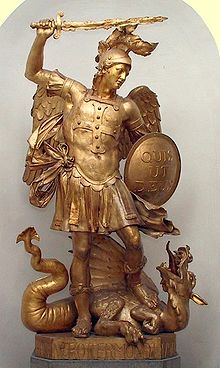
He's a defender, a psychopomp, the chief angel, the prince of the angels, the general of the army of angels, the one who defeated satan himself and cast him into hell. The holy wiki doesn't have much more on Him than Bible and Koran quotes. He's worshiped by all 3 Abrahamic religions. But does it really surprise anyone that he's so much older than that? His Imagery (wielding the sword, the scales, and standing over a man or dragon) is found elsewhere?

Mithras. The holy wiki does have something on this!

Mithras powerfully standing over a bull, about to thrust his sword/dagger into its flesh; this image is remarkably similar to later depictions of Michael standing over the devil, about to thrust a spear into him.

He was also a psychopomp!

Marduk
In Enûma Elish, a civil war between the gods was growing to a climactic battle. The Anunnaki gathered together to find one god who could defeat the gods rising against them. Marduk, a very young god, answered the call and was promised the position of head god.
He battles Tiamat, pictured as a dragon. Who do we know stands over a dragon after defeating rebelling entities? Hmmm... Marduk is also syncretized with Jupiter who is also syncretized with Thor!

One of the epithets of Marduk is "the bull-calf of the sun" which related back to our friend, Mithra!

Miok, son of Thor is yet another candidate/aspect of this archangel. Also, Michael's day of the week is Thursday aka Thor's day.

Mukhla is a Sumerian apotheosied deity. From Makers of Civilization in Race and History By L. Austine Waddell:
"The Isan chronicle... confirms from independent Sumerian sources the historical human original of Saint Michael the Archangel, vanquisher of the great dragon..."

On this date I will venerate the epitome of the defender of faith. Just because the christian's co-opted him doesn't mean they own him. I'm just glad that his spirit has not diminished for lack of energy and offerings. He is powerful and one to call on for protection, defense, healing, and as a guide too. I'll leave off tonight with a few pictures for comparison ;)

Archangel Michael slaying a dragon

Marduk slaying Tiamat, the dragon

 
Mercury. He's not slaying anything, He just seems to fit


Thor slaying Jormungard
Mithras slaying the bull

Wednesday, September 7, 2011

Ancient Ghost Town

One of the reasons behind my daily blogging is to set aside time to investigate and research and to contemplate what I know and what I only think I know. There is so very much on this topic- it's a huge body of water with a great number of tributaries. There's no way I'm going to parse all of this tonight, so come take a trip on my train of thought...

When I made my offerings eariler, I found myself in a prayer pose which I recall my Aunts using, even the ones who went to Church (tho not as exaggerated). Almost no one else in the church did this, certainly not anyone who wasn't Italian (It was a mostly Italian parish anyway!). From there, it was a quick leap to the Minoan figures of worshipers. I remember how striking they were when I saw them in person:


I took this picture in the Heraklion museum.

I meditated tonight before blogging and was reminded of my dance with Ereshkigal. I didn't really understand why until, when searching for pictures of the figures of worshipers, I came across pictures of the Minoan Snake Goddess.


I wound up looking at these pictures side by side for the first time. I've known about Ninhursag, but somehow I've never connected these two pictures before.


Ninhursag, meaning "Lady of the Mountain," is the Sumerian Earth Goddess/Mother Goddess. Her attributes were later subsumed into Inanna/Ishtar. If you are unfamiliar with this Goddess I highly suggest this article. "In art, Ninhursag is often depicted with a tiered skirt, often with a horned head-dress. She sometimes carries bow cases at her shoulders, and/or a mace or staff with an omega motif at its top."

What really has me in a tizzy tonight is this article I've found on the links between Egypt and Crete. I would love to just post the entire article here on the blog. Instead I'll summarize it and add a few excerpts of interest, tho I have to say the entirely article is fascinating and makes a lot of sense. I would love to hear from those who work with the Egyptian pantheons weight in on this. Happily, I know a few and will ask them to comment.

Points to ponder from the article:
Was Crete an Egyptian colony, with care for the dead their primary occupation?
Were the "palaces" of Crete actually temples?
These were made of gypsum, when limestone was available.
No artifacts of daily living or waste have been found in the complexes
The stairs showed little sign of travel
There are identical processional paintings, of the same age, found in both Crete and Egypt; They speak of an island, identified in Egyptian sources as “Keftiu” – Crete.
The Phaistos Disc, found in Crete, might be a version of the Egyptian the snake game, Senet, which became an important funerary object and a metaphor for ascending to Heaven.

An excerpt:

The bull was important both in Crete and Egypt. In Egypt, the animal is linked with the deceased king, whereas the bull is depicted on all Minoan monuments, though its specification function is unclear, because of the absence of any knowledge on the Minoan religion. The palaces depict lilies and lotus flowers, plants that had an important, religious function in Egypt.
The Minoan palaces have a depiction of what is known as “bull leaping”: people performing acrobatics on a leaping bull. Experts have identified that this form of acrobatics is physically impossible – humans and bulls cannot interact in such a manner. The question is therefore whether these scenes depict “imaginary” scenes, i.e. scenes that might occur in the Afterlife?
The name of king Minos is identical to the first king of the Egyptian First Dynasty, Menes. But in the Homeric legends, Minos is not so much king, as a judge, “wielding a golden sceptre while dispensing laws among the dead.” If Minos ruled Crete, Crete was therefore an island of the dead.                  

YES! It makes such perfect sense to me.

Talking to hubby about our time in Knossos and about the rest of our experience in Greece in general, we both agreed that the "palace" felt very different than the other sites we visited. It was quieter in a way. I don't mean lack of tourist quieter, I mean energy of life quieter. We explored out of the way places like Eleusis and popular places like the Parthenon and Delphi- It wasn't a matter of how many tourists were around, it was the quality of the energy. There was a palpable difference. Despite the presence of people and a booming tourism industry, Knossos felt like a ghost town. According to this article? Literally.

And this isn't even getting into the Labyrinth, or Ariadne, or the Goddess cult on the island before it was colonized by Egypt or claimed by Greece! Another time!

Thanks for following my train tonight. Here are a few more pictures from that trip:

"Horns of Consecration"

The Prince of Lilies doesn't look Egyptian at all...

I thought this was just darn cool.