Showing posts with label Rome. Show all posts

Wednesday, February 1, 2012

You call it Imbolc. We call it Februarius.

There are so many feasts and festivals upcoming and ongoing depending on the region, especially from pre-Roman times. Today we celebrate the return of Proserpine, or Kore to Her Mother and the upper world. To this day Catholics celebrate by lighting candles to the Queen of Heaven and blessing the candles. Celts celebrate Brigid/Imbolc. The Norse celebrate Freya.

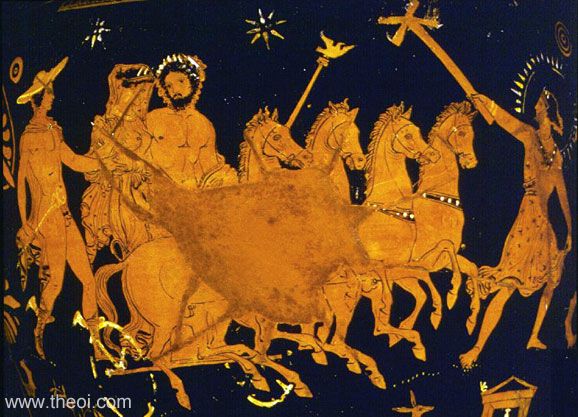
Return of Persephone, with Hades, Hermes & Hecate | Greek vase, Apulian red figure krater
The Return of Persephone
February is named for Februus, a possible Etruscan deity of purification and of the underworld. Perhaps an epithet of or akin to Pluto? I've seen the names Februa and Februatio in my studies as possible Sabine deities. Are they a Sabine divine pair who jointly ascend? The picture above shows Proserpine being returned to the upper world b Pluto and flanked by Hermes and Hecate.

This is the month of purification, of spring cleaning in preparation for the new year. Soon I'll be posting about the Parentalia (the origin of many hallow's eve traditions), Lupercalia and the origins of love day (my annual whip my Roman Sex Gods re-post with additional info!), Februalia, and the Feralia, celebrating the underworld deities (see what I mean about Februa and Februato?).

Whatever name you call this turn of the wheel, I hope you have a happy one!

Wednesday, January 4, 2012

Dea Strenia

This Goddess is viewed as the pre-christian origin of La Befana. Strenia was a Sabine Goddess of strength and endurance. She had a temple on the Via Sacra and was honored at the start of the new year. Emperors would receive gifts at Her temple and the monies collected were used for the upkeep and expansion of the public temples of the Roman state.


From the book Vestiges of Ancient Manners and Customs, Discoverable in Modern Italy and Sicily by Rev. John J. Blunt (John Murray, 1823):
"This Befana appears to be heir at law of a certain heathen goddess called Strenia, who presided over the new-year's gifts, 'Strenae,' from which, indeed, she derived her name. Her presents were of the same description as those of the Befana—figs, dates, and honey. Moreover her solemnities were vigorously opposed by the early Christians on account of their noisy, riotous, and licentious character."
From the book Domestic Life in Palestine, by Mary E. Rogers (Poe & Hitchcock, 1865)::
"An 'Essay on the Fine Arts,' by E. L. Tarbuck, led me to believe that this custom is a relic of pagan worship, and that the word "Bastrina" refers to the offerings which used to be made to the goddess Strenia. We could hardly expect that the pagans who embraced Christianity could altogether abandon their former creeds and customs. Macaulay says, "Christianity conquered paganism, but paganism infected Christianity; the rites of the Pantheon passed into her 'worship, and the subtilties of the Academy into her creed.' Many pagan customs were adopted by the new Church. T. Hope, in his 'Essay on Architecture,' says: 'The Saturnalia were continued in the Carnival, and the festival with offerings to the goddess Strenia was continued in that of the New Year…'"


From The Roman Forum: a topographical study:
"The Roman antiquaries inform us that the term Sacred Way is applicable to a road leading from the Sacellum (chapel) of the Goddess Strenia, in or near the Carinae, to the Capitoline citadel..."
Christmas and epiphany gifts in Italy are still called strenae .  

Here we have a Sabine Goddess (remember il rapimento delle sabine?) who is honored at the start of the year with gifts of sweets and boughs from Her sacred grove and with money. It's not a leap to surmise Her worship was continued as La Befana, or as the personification of La Epifania. 


This Friday I'll be exchanging strenae with Family, making a donation of money in Her name, donating shoes and coats, and sharing the vegan struffles I'm making for the occasion!


Sunday, December 25, 2011

Happy Birthday, (insert Solar Diety here)!

"It was a custom of the Pagans to celebrate on the same 25 December the birthday of the Sun, at which they kindled lights in token of festivity. In these solemnities and revelries the Christians also took part. Accordingly when the doctors of the Church perceived that the Christians had a leaning to this festival, they took counsel and resolved that the true Nativity should be solemnized on that day."
- -Bishop Bar-Salibi, 1150's


I promised a post about Dies Natalis Solis Invicti so here it is!

This is a cult from the later days of the Roman Empire. There are arguments about which deities from which regions were conflated into the figure of Sol, including Helios, Apollo, Mithras, El-Gabal and Jupiter.  Jesus was even given the title "Sun of Justice" in the early days. Sol Invictus was paired with a Eagle who acted as a psychopomp to unite souls with Sol. Not surprising as the eagle is associated with several father figure deities.

Constantine, allegedly the first emperor to convert to Christianity, was of the cult of Sol Invictus. They are pictured on coins together, he had his triumphal arch built to align with the massive statue of Sol.  Constantine also declared Sunday as a Roman day of rest. He ordered all businesses to close but exempted farmers in case a Sunday was the best day to work the land.

What I find interesting about Constantine and Sol Invictus is that, combined with the cult of Mithras, we have almost the whole of modern Christianity. I suggest at least perusing The Cult of Sol Invictus by Gaston Halsberghe and The mysteries of Mithras: the Pagan belief that shaped the Christian world  by Payam Nabarz.

In the later book, the author describes the two cults as inexorably linked, with Sol as either the father of Mithras, or bowing to Mithras, with the lather placing the Phrygian cap on his head. Many of the customs and traditions, and even philosophies of the cult of Mithras can also be found in the cult of Christ.

As much upheaval as there was when Christianity became the dominant religion, the idea of a single deity with an avatar (son) on earth was very familiar. I've talked about how there was nothing new in christianity and I've found the exception that proves the rule: While the cult of Mithras and the cult of Sol Invictus were not only accepted but quite popular, they did not try to suppress the other cults. They did not try to obliterate the other deities. That was something new christianity brought to the table. Yes, Rome suppressed cults and killed magnetic cult leaders, but that was to quash political uprisings, not because they particularly cared what people worshiped. There is evidence in Libya that while Rome brought their holy triad to the land after conquering it, the local deities were never suppressed and in fact pictured along with the triad in reliefs. If anything, examples such as moving the bones of Orestes and bringing the cult of Diana from Aricia to Rome show that while they wanted Rome to be the center of power, they did it in a way which didn't try to change the beliefs of the people, just the way they tithed. The rituals of the state were transferred to Rome, but relatively unchanged. The rituals of the home remained untouched because they didn't effect public life. Something to chew on for a while.

There is a nifty theory on the symbolism of Mithras and the Bull and the precession of the equinoxes and the Ages. When Taurus was on the horizon at the Spring equinox, it was the Age of the Bull. Does Mithras killing the bull imply he ended the Taurean age and began the Age of Ares? The Age of the Ram? The symbolism of the fish may be tied to earlier Goddess imagery, but it could be as simple as representing the Age of Pisces. Info on the Age of Ares from the holy wiki:

Aries represents a Fire symbol as well as bold actions, a lot of these behaviors can be seen during any age. However, the themes emphasised during this age relate to courage, initiative, war & adventure. Nations during this age such as the expanding empires of China, Persia, Greece and Rome, are often cited as examples of the archetypes of Aries in action.
Aries is associated with the metal iron, and iron ore was for the first time smelted and worked into iron swords in Anatolia during the early phase of this era, replacing the heavier, softer-metalled, duller-edged bronze swords of the previous Taurus Age.

Let's conclude tonight with one of my favorite hymns to Apollo (or to your solar deity of choice!) on the occasion of his (re)birth. Sing along with me!

Joy to the world! the Lord is come;
Let earth receive her King;
Let every heart prepare him room,
And heaven and nature sing, And heaven and nature sing,
And heaven, and heaven, and nature sing. 

Joy to the world! the Saviour reigns;
Let men their songs employ;
While fields and floods, rocks, hills, and plains
Repeat the sounding joy, Repeat the sounding joy, Repeat, repeat the sounding joy.

He rules the world with truth and grace,
And makes the nations prove
The glories of His righteousness,
And wonders of His love, And wonders of His love,
And wonders, wonders, of His love.
Monday, December 5, 2011

Let the good times roll...

Since this isn't a "Pagan 101" blog I haven't felt the need to post about how every single tradition currently associated with christmas was already a well establish Pagan tradition that the christians once railed against but eventually adopted. There, I just did. Actually, they did. I adore the annotated rant folks and wish they would rant on! Or at least update their old stuff!  Glad that was covered! However! I'm not going to let this stop me from posting about something fun.

I was writing a snarky post about how I plan to have a holiday party this year: It will include feasting, cakes, candy, alcohol, lights, decorations, hat wearing, gift exchanges and gambling. No, it's not to celebrate christmas." It's a Saturnalia party!

Most of the Saturnalia traditions made it into the general christmas traditions: The gift exchange, the stockings by the fire, the man with a long beard and flying mammal leaving gifts in exchange for an offering, the mistletoe, the chestnuts, the bells, even the hats. Don't forget "The Yule Log." They didn't even bother to change the name on that one...

What you don't hear about in the holiday songs is gambling! One of the many Italian traditions, at least Italian-American traditions, is gambling!

Here's how La Vigilia (christmas eve) went in my family:
We all went over to Aunt Mary's house (My Grandfather's sister, the eldest sister and matriarch of the family)
There was the antipasto, candy and snacks
The feast of 5 fishes... seriously, it makes my kinda nauseous to think about, but that was it, you don't eat meat on La Vigilia. But you do have 5 different fish courses and a pasta course with fish sauce. Happily, the deserts didn't include fish.
What a table full of sweets! Home made pastries, cookies, strufles, cakes, chocolate, and fruit and nuts too lol
After the gift exchange (which, when there were little kids at the celebration, included a man in a red suit with a long beard handing them out) the women would go downstairs to play pokeno and the men would be upstairs playing poker.

The tradition of gambling continues! I have no idea why this never clicked with me before. I've known both facts, that Saturnalia included public games (In my mind the whole of ancient Rome turned into Vegas for a week!) and that on La Vigilia but the neural pathway connecting these two things did not exist until now. Means I need more sleep. Off to do that now!

Tuesday, November 29, 2011

Migration Patterns

No one knows better than a bird of the air where treasures are concealed.
- Aristophanes The Birds


I'm not a bird watcher, I can't pick out rare birds at a hundred yards, but I know the basics. I can spot a finch, a blue jay, a cardinal, a sparrow, a woodpecker, crows, and my special friends, hawks.

In Etruscan Magic, Leland wrote about birds in regard to finding treasure and in Aristophanes' The Birds, the scene opens up with two characters each carrying a bird to point the way to go. Etruscan augurium ex avium was concerned with the sounds birds made as well as the number of birds and the pattern of their flight.

We have some records of the Roman practice of Augury. We can only wonder if it was imported entirely from the Etruscans, or changed to suit the Romans, or both.

Something interesting from the holy wiki:
The lituus was a crooked wand (similar in shape to the top part of a crosier) used as a cult instrument in ancient Roman religion by augurs to mark out a ritual space in the sky (a templum). The passage of birds through this templum indicated divine favor or disfavor for a given undertaking.
A templum was the sacred space defined by an augur for ritual purposes, a place "cut off" as sacred. It could be created as temporary or permanent, depending on the lawful purpose of the inauguration. Auspices and senate meetings were unlawful unless held in a templum; if the senate house (Curia) was unavailable, an augur could apply the appropriate religious formulae to provide a lawful alternative.
To create a templum, the augur aligned his zone of observation (auguraculum, a square, portable surround) with the cardinal points of heaven and earth. The altar and entrance were sited on the east-west axis: the sacrificer faced east. The precinct was thus "defined and freed" (effatum et liberatum).
In most cases, signs to the augur's left (north) showed divine approval and signs to his right (south), disapproval. Stone-built temples followed this ground-plan and were sacred in perpetuity.

I've been quite taken with the pattern of bird flight lately. Look up, they'll let you know what's going on. I'm a believer in personal symbolism when it comes to divination be it tarot, tea leaves, pendulum or bird flight patterns: If you think a rose is a good omen, then it's a sign of good omen if it comes up in a tarot spread or in the formation of the tea leaves, or in the pattern of the birds.

If you take the time to center, you can see what the birds are telling us, and hear it too.

What does the pattern look like?
What is the sound? The rhythm?
Who is the bird sacred to?
Where in the sky?
Which direction are they traveling?

It's a big difference in meaning to have sparrows fly in a certain pattern or to have hawks fly in that pattern!

This is not only employed with flocks of birds, but also with single birds you might encounter through the day. I've often had birds chime in at different points in rituals when celebrating outside. This is the kind of this children learn at their parent's and grandparent's knee. It's typically a see and do process, not a lecture and private practice.


To start is easy, especially if you have any kind of background in divination and/or meditation:

Breathe, tune in to your blood flow, listen, look, receive, record

May your bird watching be auspicious!

Tuesday, November 22, 2011

The Festival of Juno at Falisci -Ovid

I have a headache tonight, so I am indulging in tea, poetry and pretty things to look at. Won't you join me for a quick trip to Etruria with our friend Ovid?

The Festival of Juno at Falisci -Ovid

As my wife was born at fruitful Falisci, we went to visit those walls which long ago were conquered, Camillus, by thee. The priestesses were making ready to celebrate the festival of the chaste Juno by holding solemn games and by the sacrifice of a heifer native to the place. It was a strong motive for lingering there awhile, to witness the rite, though full steep is the path that leads to the scene of its performance.

It is an immemorial grove, and so dense is the foliage there that the daylight cannot penetrate the gloom. One needs but to behold it, to realize that it is the abode of a divinity. An altar receives the prayers and incense offered by the faithful, a rough-hewn altar made by the artless folk of olden days.

From this spot, once a year, as soon as the trumpet has given forth its solemn note, the procession sets out and makes its way along the carpeted paths. Snow-white heifers are led along amid the plaudits of the throng, heifers nourished by the grass of their native fields, and calves whose brows are not yet armed with threatening horns, and the humble pig, a lowlier victim, and the leader of the herd with horns curved back over his stubborn head. The goat alone is hateful to the Lady Goddess, ever since the day when by a goat her presence was betrayed in a deep wood and she was forced to abandon her flight. And so, even now, the boys pursue her with their darts and she is given as a prize to the one that brings her low.

All along the way the Goddess is to pass, boys and shy maidens strew the paths with carpets. Gold and gems sparkle in their virgin hair and the proud mantle hides their gold-decked feet. In the Grecian manner of their ancestors they pass on, Clad in white, and on their head they bear the sacred vessels entrusted to their care. Peep silence holds the people while the stately procession is passing by, and after her priestesses, follows the Goddess herself.

The whole procession tells of Greece. After the murder of Agamemnon, Halesus fled the scene of his crime and the rich lands of his forefathers. It was only after many adventures, both by land and sea, that with auspicious hands he reared a high-walled city. ’Twas he that taught the Falisci to celebrate the rites of Juno. May they to me, and to her own people, ever be propitious.
 ~~~

I couldn't resist a bit o history:
Falerii Veteres reached its zenith in the fifth century BC, confirming undisputed political and cultural capital of Faliscan. Several findings attest to the importance of the city, as the temple of Juno Curite and the temple of Mercury whose remains are on display in Rome.

 The temples actually go back to Uni and Turms!

Saturday, November 12, 2011

More calendrical bullshit

Way too many people have been talking about 11/11/11. Facebook has been effing flooded with hippie fluffy crystal bunny new age run amok namby-pamby fluffernutter hooey. Yep, it's rant night. The Etruscans and Romans had their market days, and I have my rant nights.

I don't understand the appeal. Hubby calls it odometer mentality. It's nice to see the numbers roll around and be all symmetrical and what-not. Hmm I disagree with hubby- it's not "odometer mentality." It's Jackpot mentality! Hate to have to be the one to tell you this:

You don't automatically win something just because some numbers matched up!


I've posted here many times on the calendar fuckery from different societies and different cultures and who imposed what on whom. So this is 11/11/11 in the current era Gregorian Calendar which everyone uses so the world can do business. Fanfrickintastic. However, this is not the first calendar, nor is it the last calendar. Nor is it the only calendar.

Today is also 14 Cheshvan, 5772. 
The Assyrian calendar is up to 6761.
It's 12011 in the Holocene calendar, dating from the start of the Human Era.
The Berber calendar is nearly at 3k. Will people go batshit crazy on 03/03/3000? Not likely.

The only thing special about this day is the attention being given to it. Sounds like Snooki. If you can elevate this date in your mind, why not any date? Why not wake up and decide you are more powerful now? Why not cloak yourself in power and become who and what you wish to be? Sounds a little Secret-New-Agey, but the principle is true. You have the ability to take your power up to the next level, you just need the motivation to do it. If you want to call down the choirs of Angels on a special date, or make this the first day of the rest of your life, or step through a new doorway of power and knowledge, then do it. There's no need for you to wait for some magical man-made calendar number to pop up.

Each day is unique! Each moment is unique! You can embrace this at any time. Let me rephrase this: You can embrace any time. Find its special, unique qualities and work with them. You don't need an excuse like a random pretty looking number. Just get to it!

Tuesday, November 8, 2011

I Just Did Something No Roman Woman Did...

Today I voted in my local elections. Women in Italy were denied the right to vote until 1925 and that was in various localities, not the whole of Italy. Women weren't entirely shut out of politics, however. There are walls in Pompeii painted with campaign ads from women endorsing candidates:
"Nymphodotus, along with Caprasia, asks you to vote for Marcus Cerrinus Vatia for the aedileship." Another, found on the side of a wine shop reads: "Caprasia along with Nymphius -- her neighbors too -- ask you to vote for Aulus Vettius Firmus for the aedileship; he is worthy of the office."
If you're curious, here's an interesting chart breaking down the positions (and responsibilities) of government in Rome. I've also come across more nifty history. I can't decide if I like this better than the computers we vote on nowadays:

SUFFRA′GIUM: to vote.
It is commonly supposed that at Rome the people were always polled in the comitia by word of mouth, till the passing of the Leges Tabellariae about the middle of the second century BCE [Tabellariae Leges], when the ballot by means of tabellae was introduced.

Popular assemblies voted by ballot, as well as by word of mouth, long before the passing of the Leges Tabellariae, but that instead of using tabellae they employed stones or pebbles and that each voter received two stones, one white and the other black, the former to be used in the approval and the latter in the condemnation of a measure. The voting by word of mouth seems to have been adopted in elections and trials, and the use of pebbles to have been confined to the enactment and repeal of laws.
Exciting, I know! Basically, you had to be an adult male landowner to vote, but that doesn't mean women had no say at all. They caused scandals when need be, including the protesting of the Oppian laws where the women showed up in the Forum and lobbied the men to repeal law that women would not be allowed to spend money. I wonder if it was a Lysistrata type situation... hmmm!

Anyway, not to bore you entirely with the legislative situation in Rome (which is more like our modern American system than anyone really wants to admit, and might have been a better one except for all that land owning patrician sexism).

Tonight is also the opening of the Mundus and The Eastern Orthodox feast of Michael the Archangel. In some traditions the date is dedicated to the "Dark" aspects of Michael, the one who reaps Justice and takes retribution. Call on him only if no one could call for justice or retribution against you. Are you pure enough to cast the first stone, so to speak? Is your heart lighter than a feather? Would Ammit devour you? His sword is double-edged. Be wary of calling upon it.

No comments on my Whipping post? I'm terribly disappointed! Perhaps it's time to post part 2? ;)

Sunday, November 6, 2011

Private vs Public

Last week was the very public celebration of Hallows Eve. However, it wasn't the astrologically correct celebrations of Hallows. That happens just after midnight on Tuesday when the sun reaches 15 degrees Scorpio. It coincides with the opening of the Mundus, an act which was allegedly adopted from the Etruscans wherein the portal to the underworld is opened and the spirits of the dead are allowed to roam for a time and food along with other offerings are tossed into the pit as an offering to the spirits of the departed and of the land.

With all of the hullabaloo last week, I wasn't able to do anything grand, as I am wont to do, so I will be out in my Grove tomorrow night working the work. Something to keep in mind, as one of my compatriots reminded me, is that most festivals lasted for day. I also wanted to add that there were both public and private aspects to most festivals. Duty was done in the home, on the private land, in the town center, in the temple and in whichever place was sacred to the deities or spirits involved in the celebration. My obligation to the public face of this holiday has been fulfilled and now it is time to fulfill my obligation at home.

From our Nova Roma friends:

Gate to the underworld
One such stone covered the mundus Cereris, a pit thought to contain an entrance to the underworld. Most cities of Latium and Etruria contained a similar pit or ditch; Plutarch describes the custom of a mundus as being of Etruscan origin, and states that it was used as a place where first-fruits were deposited.

The Latin word mundus simply meant "world".  Festus, quoting Cato this time, explains that:
Mundo nomen impositum est ab eo mundo qui supra nos est.(The mundus gets its name from that world which is above us.)

The Roman mundus was located in the Comitium , on the Palatine Hill. This stone was ceremonially opened three times a year, during which spirits of the blessed dead (the Manes) were able to commune with the living. The three days upon which the mundus was opened were August 24, October 5, and November 8. Fruits of the harvest were offered to the dead at this time.

"When the mundus is open, it is as if a door stands open for the sorrowful gods of the underworld. -Varro

Check out this cable published in the NY Times nearly 100 years ago! 


My feast will conclude on Thursday with the full moon. Then on Friday we'll turn our attention to the winter holidays and the week of decorating! Until then my halls will continue to be decked with black, purple, orange, pumpkins, ghosts, masks and other accoutrement of this hallowed holiday.

Upcoming topics: Daylight savings, Magic of the Renaissance, and, suggested indirectly by a paisan: "Who was the first one to look at an artichoke and decide that it would be a tasty treat?" Yeah!

Friday, October 28, 2011

Dowsing

While out and about tonight I had to procure a bottle of water. The choice was limited, but let's say the brand I grabbed inspired the title of this post as well as the post itself. The label had some promo stuff about water dowsing in ancient Egypt and Rome and implied that their company used such classic methods to source the water in the bottle I was holding. I don't really believe they had someone out there water dowsing, but it was nice to see ancient methods being portrayed in a positive way.


As I'm short on time tonight I'm going to punt and start off with a few interesting links then revisit this topic as soon as possible!

Wiki is a nifty springboard to other sources on this vast topic.

A history of dowsing (with many links of interest!)

Archaeological Dowsing

The US Department of the Interior has an article on water dowsing. This link takes you tot he download of the pdf!


"Some Sorcerers do boast they have a Rod,
Gather'd with Vowes and Sacrifice,
And (borne about) will strangely nod
To hidden Treasure where it lies;
Mankind is (sure) that Rod divine,
For to the Wealthiest (ever) they incline." -by Samuel Sheppard
 

Monday, October 10, 2011

There's something fishy about this symbol

We know that most Christian symbols and images have Pagan roots: The cross, Mary's titles and dress, the rosary, the chalice/wine and bread, crossed keys, the dove, the lamb, the egg, the triskele, the halo, the palm, sea shells, the stag, the triangle... Also... The Fish! Another symbol for us to reclaim!

Hubby passed along this nifty article (again the atheists come through with the research!) and I want to share excerpts with the Loyal Horde:

But contemporary Jesus worshippers might be surprised, even outraged, to learn that one of their preeminent religious symbols antedated the Christian religion, and has its roots in Pagan fertility awareness and sexuality. Barbara G. Walker writes in "The Woman's Dictionary of Symbols and Sacred Objects," that the acronym pertaining to Jesus Christ was a "rationale invented after the fact... Christians simply copied this pagan symbol along with many others." Ichthys was the offspring son of the ancient Sea goddess Atargatis, and was known in various mythic systems as Tirgata, Aphrodite, Pelagia or Delphine. The word also meant "womb" and "dolphin" in some tongues, and representations of this appeared in the depiction of mermaids. The fish also a central element in other stories, including the Goddess of Ephesus (who has a fish amulet covering her genital region), as well as the tale of the fish that swallowed the penis of Osiris, and was also considered a symbol of the vulva of Isis.
Well before Christianity, the fish symbol was known as "the Great Mother," a pointed oval sign, the "vesica piscis" or Vessel of the Fish. "Fish" and "womb" were synonymous terms in ancient Greek,"delphos." Its link to fertility, birth, feminine sexuality and the natural force of women was acknowledged also by the Celts, as well as pagan cultures throughout northern Europe. Eleanor Gaddon traces a "Cult of the Fish Mother" as far back as the hunting and fishing people of the Danube River Basin in the sixth millennium B.C.E. Over fifty shrines have been found throughout the region which depict a fishlike deity, a female creature who "incorporates aspects of an egg, a fish and a woman which could have been a primeval creator or a mythical ancestress..." The "Great Goddess" was portrayed elsewhere with pendulous breasts, accentuated buttocks and a conspicuous vaginal orifice, the upright "vesica piscis" which Christians later adopted and rotated 90-degrees to serve as their symbol. 

Go check out the article! Quiz tomorrow!(j/k, no quiz!)

Wednesday, October 5, 2011

Son of Neptune Book Review

Loved it! I read it in a day!

Yes, I know it's a kid's book, but I really love almost anything Rick Riordan writes. The Percy Jackson and the Olympians series is a favorite of mine. It's all about the Greek Pantheon and their children, the demigods. In this spin off series, he tackles the Roman pantheon!

I can't tell you how thrilled I was to see a good description of Rome proper, the buildings, the clothing and armor, the major and minor deities, the temples, auguries.... and even the Lares! Yes, there was a comical treatment (Mr. Riordan seems to like making ghostly characters the butt of jokes), but I was delighted to just see them addressed as part of the every day life of the citizens.

One of the things I enjoyed most about the book was how they drew the distinctions between the Greek and Roman deities such as Greek Hades and Roman Pluto, and Greek Ares and Roman Mars. He illustrated the differences very well, including how Pluto was also a deity of wealth, not just death.

I was disappointed in the simplified "Romans imported the Greek Gods and perfected them" explanation. In The Lost Hero, the first book of this spin off series, Heroes of Olympus, there was the promise of a much deeper, much more clever connection between the two pantheons, much the same way Riordan explained the vast differences in Egyptian lore in his Kane Chronicles books.

We also get to experience some of the military jargon of the Roman army, including one of my favorite words: Cohort.  I love talking about my cohorts! Where'd the word come from? Italy! Ha! It's a military unit, 1/10 of a Legion.

The last nifty detail I will mention is that each of the Roman demigods gets a magical tattoo when they become an official member of the legion:


Senatus Populusque Romanus.

The Senate and People of Rome.

Saturday, October 1, 2011

Octoberfest!

I love October, and not just for Hallow's Eve purposes. There is a certain blue in the sky which only appears in October. Concord grapes are in season, the full beauty of the foliage is blossoming, and there's my birthday in there too ;) So many Witchy events this month!

There have been questions lately regarding Italian practices during this time of the year. I've actually posted about this before, in May. I suggest you surf over and read that first because it's one of the posts I actually like lol

The Major Italian festivals dealing with the dead weren't in October/November, they were in February and May. It wasn't until the 700s, when the church wanted to bring the celts into the fold, was the official "all souls day" moved to November 1st.

Around November 8th, the actual mid point between autumn and winter (aka the astrological cross-quarter), the mundus was opened and food was offered to the dead. What's a mundus? I've posted about this before too! I'm on a roll tonight with the past links. See, this isn't just a daily devotional blog, it's the foundation for future work ;) Again, the highlights: It's the center of the city where, some say, there is an access point to the underworld and upperworld. A pit was dug, offerings were made, and it was covered with a slab and an altar was erected on top of it.

Here is a link from Nova Roma describing the practice:
The Roman mundus was located in the Comitium, on the Palatine Hill. This stone was ceremonially opened three times a year, during which spirits of the blessed dead (the Manes) were able to commune with the living. The three days upon which the mundus was opened were August 24, October 5, and November 8. Fruits of the harvest were offered to the dead at this time.
This fits nicely with the feast of Pomona which took place on the 1st of November- orchards were harvested around this time and these are the fruits which were offered in the mundus.


That's all for tonight! Happy October!

Tuesday, September 13, 2011

Ludi Romani

Another effing festival? Seriously? Yeah. The Romans liked their festivals. They had so many because they also liked the festivals of the deities they co-opted from the regions they conquered and assimilated.

The Ludi Romani was the biggest festival in Rome. Sources debate the origin date, but it's ballparked around the 5th century BCE. Allegedly it started out as a quickie festival, only on the Ides of September, but with an influx of cash, the festival grew larger. Some sources claim they were held annually, others claim they were sporadic for a time but eventually became an annual event.

There were chariot races and plays and concerts and gladiatorial contests and feasts and sacrifices. Actually, I stated all of that backwards: The festival started with a procession to the temple of Jupiter where a cow was sacrificed. I've also read that the procession went from the temple to the Circus Maximus. Its likely both are correct: The festival evolved over the years in length and entertainments presented. During this festival was the Epulum Jovis, a banquet where the statues of Jupiter, Juno and Minerva, the Capitoline Triad, were adorned and sat at the table with those feasting. They were served the food on the dishes and their priests were their, as one site put it, "gastronomic proxies."

This site has some nifty information as well as the picture of a coin which shows what the Temple probably looked like.

What I can't find is the end date for the Ludi Romani. When were they no longer celebrated? Or are they still celebrated in some form? 

Aside from the historical stuff you can look up on wiki as easily as I can, what I want to focus on a bit is the legend of how the games began: Tarquinus Priscus, later known as Tarquinus the Elder, was the 5th King of Rome. However, he was from Etruria. Legend has it that he was denied political office in Etruria because his father was a Greek immigrant, so he went to Rome to find his fortune. That he did! Further, the legend tells of an eagle swiping his cap when he entered the city and placed it back on his head. I wonder who started that one! He became friends with the 4th King and when his friend passed, Tarquinus talked the senate into declaring him King. Apparently it worked. The Ludi Romani were allegedly started in honor of Tarquin's winning a military victory, which one is debated. He created the Circus Maximus for chariot races.

Little remains of the Circus Maximus, but from the evidence we have, it was effing fabulous! Biggest. Arena. Ever. I've come across a site which claims the last games held at the Circus Maximus, not specifically the Ludi Romani, were in 549 CE. A thousand years of games. Today? Pft. They knocked down and rebuilt Giant Stadium AND Yankee Stadium in the past few years. Take a gander here, and you'll be able to see what's left, which is barely the footprint.

Circus Maximus depicted on the back of a coin

So now the question is, why oh why was Rome partying while everyone else in Italy was bringing in the last harvest and preparing for winter? The games were free to all, but was this just a festival for the wealthy? More tomorrow, perhaps on what the rest of Italia was up to in September!

Sunday, September 11, 2011

The Mysterious Moon

The ancient calendar of Athens was lunisolar- it was based on both sun and moon. We know that their new year started on the first new moon after the summer solstice. We also know that the Greater Eleusinian Mysteries were celebrated from this full moon until the new moon. Tonight begins the Descent of the Goddess.

I've wanted to talk about this and to not talk about this. I feel like this mystery cult was stolen from Sicily and somehow resent it. I'll get over it and come to a greater appreciation and understanding, but that's how I feel at the moment.

In rereading the papers on and history of Lake Enna and Pergusa in Sicily, I realized something: This is the time of year the Lake would turn red:


Situated in the province of Enna in a vast grain-growing region of Sicily, Lake Pergusa is one of very few natural lakes that remain on an island famed in antiquity for its wetlands. Pergusa's basin was formed eons ago because of the sudden sinking of the earth's rock layers and is fed only by rainwater and underground tricklings, which are slightly salinated and sulfurous. Italian scientist Sergio Angeletti has noted, "This lake represents a marvelous example in microcosm ... of the formation of the ocean four to five million years ago."

The lake periodically undergoes a remarkable reddening phenomenon because of the presence of a red, sulfur-oxidizing bacterium (Thiocapsa roseopersicina) in its waters. During summer months of years in which the sulfur content reaches a critical level, the bacteria proliferate to such an extent that the lake's waters turn either partially or entirely a deep red color, and the environs smell of sulfur for miles around. Over a period of several weeks, the bacteria reduce the sulfur level; they, in turn, are eaten by a tiny, transparent crustacean; and the lake returns to its normal color. The phenomenon, which has been documented only since the twentieth century, was studied in 1932 by Italian scientist Achille Forti, who dubbed Pergusa "the lake of blood."


If you haven't read Margurite Rigoglioso's research on this, you simply must. The above quote was taken from her well researched paper. I've posted it on the blog before, but it deserves to be posted again. Tonight is a quickie because I need to go prepare for tonight's full moon festivities! Tomorrow I hope to post about what's going on in the rest of Italy at this time of year, especially Rome's Ludi Romani.

I was going to leave off tonight with a quote from this paper, but I can't pick just one! If you haven't yet read Persephone's sacred lake and the ancient female mystery religion in the womb of sicily. Journal of Feminist Studies in Religion | September 22, 2005 | Rigoglioso, Marguerite, please do. There will be a quiz later. With prizes. The prize is knowledge of a fascinating place and perspective! 


Thursday, September 8, 2011

Greased Lightning!

The planet Jupiter is now retrograde. Astrologically speaking, it's not considered that big of a deal because Jupiter is retrograde for half the year, every year. However, there is a shakeup around the 5 days or so it takes for it to slow down and turn retrograde and later turn direct once again. This Jupiter storm coincided almost perfectly with the storm of Mercury going direct. In the days it took Mercury to stabilize into direct motion, Jupiter was slowing. So many people complained that it felt like Mercury was still retrograde!

In astrology, the planet Jupiter rules many things, including luck: It's the difference between the football hitting the goal post and going in, or hitting the post and bouncing off. What do you think is more likely to happen when Jupiter is retrograde? Yeah. No goal.

Last night we had a storm which inspired this post. The lightning was amazing- the likes of which I haven't seen since I was in the Berkshires at Mount Greylock and the lightning danced with the top of the mountain. Wow!
Lightning striking the top of the Washington Monument
Here's more info on the Iuppiter, aka Jupiter, aka Dies Pater.... lots of akas.... "Iuppiter originated as a vocative compound of the archaic Latin vocative *Iou and pater..." Our Father much? ;) The link is to the Nova Roma entry for Jupiter. I respect their research and typical attention to detail. There's also a great list of epithets!

Best Jupiter quote ever, unintentional tho it might be:
"Now if the Attendants be bright as the Sun, quick as Lightning, and powerful as Thunder; what is He that is their Lord?" -Thomas Comber, 1676
Let's leave off tonight with His Orphic hymn, which is thought to have been, in it's original language, used as an invocation during the Mysteries of Eleusis.

The Orphic Hymn to Jupiter
Thomas Taylor 1824

Fumigation from Storax
O Jove, much-honour'd, Jove supremely great,
To thee our holy rites we consecrate,
Our pray'rs and expiations, king divine,
For all things to produce with ease thro' mind is thine.
Hence mother Earth and mountains swelling high
Proceed from thee, the deep and all within the sky.
Saturnian king, descending from above,
Magnanimous, commanding, sceptred Jove;
All-parent, principle and end of all,
Whose pow'r almighty shakes this earthly ball;
Ev'n Nature trembles at thy mighty nod,
Loud-sounding, arm'd with light'ning, thund'ring God.
Source of abundance, purifying king,
O various-form'd, from whom all natures spring;
Propitious hear my pray'r, give blameless health,
With peace divine, and necessary wealth.

Monday, September 5, 2011

Are you worth your salt? (some Adult content alert!)

This phrase comes from the Romans, who paid their soldiers, at least partially, in Salt. The word salary comes from the Latin world salarium, which translates to "payment in salt." The ancient world over, salt was a highly valued commodity, traded on par with gold. The Romans built roads specifically for making the transportation of salt more convenient. One such road, the Via Salaria, led from Rome to the Adriatic sea, where salt was produced by evaporating sea water.

I came across several interesting bits in the book The Etruscans outside Etruria by Paolo Bernardini and Giovannangelo Camporeale. There is speculation in this book that the Etruscans contributed salt to the trade economy for wine in particular.

Salt was another of Etruria's great resources. It was either mined, as in Volterra, or extracted from seawater in evaporation ponds that were set up along the Tyrrhenian coast. Between Ostia and Pisa the location name Saline is often found, a name testifying to an activity that had extremely ancient roots in the area. Indeed, wars between Rome and Veii that date back to the time of Romulus were fought over the possession of saltworks, which were quite productive near the mouth of the Tiber.
The role of salt in the greater economy must not be overlooked, though its traces are mostly hypothetical. Salt would explain the arrival of a substantial quantity of Euboean (Greek) pottery in Veii and Rome during the eighth century; sources date the wars between these two cities over the possession of the saltworks at the mouth of the Tiber to this same period.

Pythagoras was pretty keen on salt too: "Salt is born of the purest parents: the sun and the sea." He also said that "salt was the emblem of justice; for as it preserves all things and prevents corruption, so justice preserves whatever it animates, and without it all is corrupted."

Hippocrates lauded the use of sea water and salt baths for healing, as did texts from ancient China. Ghandi began the non violent revolution against Great Brittain with the Salt March. In short: The Brits controlled salt production and made it illegal for anyone else to produce it, even for themselves. You can read more about this on the holy wiki.

From The folklore of common salt: http://www.sacred-texts.com/etc/mhs/mhs32.htm
In Sicily, too, it is sometimes customary for the priest to place a little salt in the child's mouth at baptism, thereby imparting wisdom. Hence the popular local saying in regard to a person who is dull of understanding, that the priest put but little salt in his mouth. A similar usage is in vogue in the district of Campine in Belgium. The use of salt at baptism in the Christian Church dates from the fourth century. It was an early practice to place salt, which had been previously blessed, in the infant's mouth, to symbolize the counteraction of the sinfulness of its nature.

Here's a Roman folk tale called The Value of Salt

Enough with the history lesson! Let's get to business!

Salt protects. It was used in mummification and in meat production to preserve. So wouldn't it protect metaphysically too? One of the things we look to when we commune with The Horned God is protection. We wear a horn. We flash the mano fico. This highly valued, magical protection powder we are talking about now is white and salty. Have I drawn enough of a picture? No? It's divine spunk. There, I said it. The preserver and protector in mineral form. A man's ejaculate is a reflection of the divine male spark. Salt is the stuff of life. Marry it with the waters of our mother's womb and there we have the primordial ocean from which Love herself, and life sprang forth. Too much?* After my Priapus post you know we don't shy away from these topics here :)

Many magical traditions use salted water representing the union between male and female, the ultimate means of cleansing and preserving all in one. Salt in the corners of the room repels negativity. Salt before your door will negate anyone or thing trying to bring evil into your home.

Aside from constantly tending the fire, the other main job of the Vestal Virgins was to make the Mola Salsa, the salted cake. It was used to purify sacrifices and alternately burned as an offering. I find it interesting that this tradition was introduced by Pompilius, the second King of Rome, who happened to be Sabine. The cakes were less like KFC biscuits and more like, say wafers. Also interesting is the fact that many nunneries used to produce the communion wafers.

The salt and grain was, and is, used to purify a space. In modern times, when moving into a new home, bread and salt are brought in to ensure protection and prosperity.

Don't want someone to return to your home? Put dash of salt in their shoes. Can't get their shoes off surreptitiously? Throw the salt on their tracks as they leave.

Salt can be used to delineate sacred space aka cast a circle.

You can trace sigils in salted water to root protection wards on your body or property or windowsills. Keep some in a small pouch in your car, tied with a red ribbon.

We haven't even gotten into the uses of black salt yet! I'll direct you to  Lucky Mojo who has a whole page on the uses of salt. http://www.luckymojo.com/salt.html

And don't forget: *Take these blog posts with a grain of salt ;)

Monday, August 1, 2011

Buona festa della Cornucopia!

I'm under the weather tonight so I'm going to take it easy. Hope you enjoy my fevered ramblings!

I saw HP 7.5 today. It should have been called: Harry Potter: The Initiation. Best line of the entire series, courtesy of Dumbledore: "Of course it's all in your head, Harry, but why should that mean it isn't real?"

Cornucopia reading led me to the legend of Amalthea, who is said to have been the foster-mother of Zeus while he was an infant and hiding from Cronus. I love the wiki quote on this one:

In Greek mythology, Amalthea or Amaltheia is the most-frequently mentioned foster-mother of Zeus. Her name in Greek ("tender goddess") is clearly an epithet, signifying the presence of an earlier nurturing goddess, whom the Hellenes, whose myths we know, knew to be located in Crete, where Minoans may have called her a version of "Dikte"
Amalthea's skin, or that of her goat, killed and skinned by the grown Zeus, became the protective aegis in some traditions, a vivid enough metaphor for the transfer of power to this Olympian god from that of the goddess who preceded his cult.


That's been a theme here, hasn't it? Digging back to see where the ancient patriarchy usurped the matriarchy... Is this another reason why Isis is so adored? Because she took power from Ra and placed Osiris and Horus on the throne? Here again we have Goddess as King-Maker in the realm of the living and of the dead.


I also find it interesting that today is the "Birthday of Isis" and in 2 weeks it is the Feast of Diana (Nemoralia) and the Greek Feast of Hecate and the Feast of the Assumption of Mary. Coincidence? Not so much.


Abundantia is depicted as carrying the horn of plenty, as were other Goddesses, but she is the one many picture. This point in the year is indeed the time of plenty: fruits and veggies are ripe, the fields are about ready to harvest and as Gershwin put it: "Summertime and the living is easy."


To close, here's funny to share with readers who aren't on my Facebook: A friend waxed snarky about the perils of being a bystander to the Feast of Cybele amongst other Mystery/Initiate undertakings and lamented that "those were the days." That phrase happened to get a song stuck in my head, so here it is, the Ancient Ways Lament:


Boy the way Apollo plagued,
Goddess Feasts and Cult Parades,
Vestal Virgins had it made,
Those were the days.

And you knew the Mysteries then,
Some for Women some for Men,
Goddess, we could use an Emperor like Hadrian again.

Rome had the largest Cult of State,
Overflowed libation plates,
Triple Goddess cakes taste great,
Those were the days!

(If you don't know which tv show theme song that was from, you might be too young to read this blog. But only slightly ;)

And welcome to our newest team member, Word, who will hopefully provide us with a few to muse about. 

Thursday, June 23, 2011

Milestones!

Woooooah.... we're halfway there...

Ack- Bon Jovi is stuck in my head! And likely now in yours too! I mean to post this the other night, but I got off on a tear about something or other, as usual, and didn't even mention it: I've blogged every day for half of the year. That went by really fast! I know not every post is a "winner" but that's not the point of blogging daily for a year. I don't know how I feel about this milestone, so I'll talk about literal ones:

The Golden Milestone and the Mundus, or the Navel of Rome, have been conflated and conflicted for ages. No one can agree on if they were related or the golden one was just a fancy version dedicated by Augustus Caesar. The Golden Milestone was the zero marker from which all distance to other cities was measured.

In reading about both and their relationship to each other, I came across this section of a book, Historical Tales: The Romance of Reality from 1896. (Seriously, one day I need to look up what major planetary aspects were going on in the 1890's because so many books about ancient Italy were written in that time frame). This is interesting, at least to me, because it's not just about the founding of Rome, but how it was consecrated, and how he went to the Etruscans to learn how to do it!

Far back in time as it was when this took place, Italy seems to have already possessed numerous cities, many of which were to become enemies of Rome in later days. The most civilized of the Italian peoples were the Etruscans, a nation dwelling north of the Tiber, and whose many cities displayed a higher degree of civilization than those around them. From these the Romans in later days borrowed many of their religious customs, and to them Romulus sent to learn what were the proper ceremonies to use in founding a city.
The ceremonies he used were the following. At the centre of the chosen area he dug a circular pit through the soil to the hard clay beneath, and cast into this, with solemn observances, some of the first fruits of the season. Each of his men also threw in a handful of earth brought from his native land. Then the pit was filled up, an altar erected upon it, and a fire kindled on the altar. In this way was the city consecrated to the gods.

Having just consecrated my own piece of land to a specific purpose, I thought the timing was fitting. I know this is likely just a story and there is no specific evidence supporting the idea that Romulus went to the Etruscans to learn how to consecrate his city (and no reason why they would help him to do this...). I thought it was an interesting idea. More tomorrow!

Saturday, April 2, 2011

Modern Rome

Almost every day, especially in the warmer months, a festival is celebrated in the city, most of which are yearly traditions with their particular ways, and where they take place and what happens and which group runs it. Things are done very differently in most areas of the rest of the country, including different versions of celebrations, different dialects, different lingo, etc.

Ancient Rome? Newp. Modern day NYC.

The USA is Italy. New York City is Rome. D.C. is Aricia lol  New York is unique to the rest of the country, as was Rome to Italy. Many other towns might have their local celebrations, but what's televised nationally? The NY Thanksgiving Day Parade. The NY Columbus Day Parade, and so on.

So what's this all about tonight? Just trying to put things into perspective. I have a calendar of Roman festivals. Note that it's not a calendar of ITALIAN festivals. The modern group isn't Religio Italia, it's Religio Romana.

There are smaller celebrations of various holidays in some areas around the US, or they're not observed at all, but you can make a pretty safe bet that no matter how obscure a holiday, it will be celebrated in NYC and if it's a big holiday? New Year's Eve is celebrated where? Times. Square.

I believe it was the same thing in Rome, especially if Rome had a vested interest in moving the seat of power from a city they conquered to assimilate them. This post seems a bit fluffy but, thinking about it this way, I feel like I have a deeper understanding of what the relationship of Rome to it's neighbors was like, especially in regard to being the seat of an official celebration.