Showing posts with label Temple of Diana. Show all posts

Friday, December 9, 2011

Reverse Guest Blog!


A few fine folks have been guest bloggers here. Tonight I'm doing a reverse guest blog! I'm currently reading the blog Diana's Mirror. Arianna posted something today (yay!). I thought it was going to be brief, but to my delight it's quite lengthy and touches on many different subjects and issues! All of which needs to be read by everyone. It's the common Pagan sense stuff which isn't all that common anymore amongst Pagans.


So tonight, please surf on over to Diana's Mirror and join in the conversation!

You should also check out her blog entry: Strega, Who are We?

Friday, October 14, 2011

The Ephesian Letters and Temple of Diana

What are they? They're a collection of ancient words and no one knows what they actually mean:

“Askei Kataskei Eron Oreon Ior Mega Samnyer Baui Phobantia Semne.”


There are other words too, but this sentence is the one currently in fashion. It's taken from one of the Greek Magical Papyri (PGM) called the "Charm of Hekate Ereshkigal." I don't know why Hekate's name is in there because all references, including imagery are of Ereshkigal. The two were certainly conflated, but Pesephone has more in common, it seems, with Ereshkigal than Hekate does. Mmmm syncretism... The translators of the PGM seem to believe this is a statement of initiation and translates to "I have been initiated, I have seen what lies in the dark (virgin, bitch, etc) and I have returned." Makes sense- this charm is about the Goddess of the Underworld and escaping punishment there- those who are initiated get some benefits, and this was supposed to be one of them, including the Mysteries of Eleusis and of Samothrace.

By the 4th centure BCE they were already noted as famous. In fact, "aski kataski" was slang for Magic. 


Many modern practitioners, including Sortia d'Este, have associated the Ephesian Letters with Hekate because of a reference to a dog here and Brimo there... However, the very charm which references Brimo (which was an epithet applied to many Goddesses including Diana) is called the Bear Charm. Artemis is associated with the bear, not Hekate. Brimo, as an epithet has also referred to Diana, Demeter and Persephone as well as the Furies.

The Temple of Diana/Artemis at Ephesus is where these magic words were carved. Where were they carved? On the statue of Diana!!! Not on a statue of Hekate. This is why they are the Ephesian letters, because they were carved on the Cult Image at Ephesus! No disrespect to the Lady of the Dark Moon, I just want to give Diana her due.

Here are some ancient references to the then already famous Letters. You'll find others here:

He walks around those getting married, speaking the Ephesian warding magics. 
–Menander, Kock Com. Att. Frag. III, 108.


Androkydes the Pythagorean, indeed, says that the so-called Ephesian letters, which were well-known among many, were of the order of symbols. And he said that Askion is darkness, for this has no shadow; and Kataskion is light, since it casts a shadow with its rays; and Lix is the earth, according to the ancient name; and Tetrax is the year, according to the seasons; and Damnameneus is the sun, the tamer; and Aisia is the true word. And truly the symbol signifies that the divine things have been set in order: darkness to light, the sun to the year, the earth to every kind of genesis of nature.
–Clement of Alexandria, Stromata V, 8, 43


So now the question is: Are you going to use a phrase when you don't know what it means?  Are you going to claim to be an initiate if you haven't been initiated (assuming that is the correct translation)? My answers tomorrow in part 2!

Saturday, January 29, 2011

Back in the day. 10,000 years back in the day.

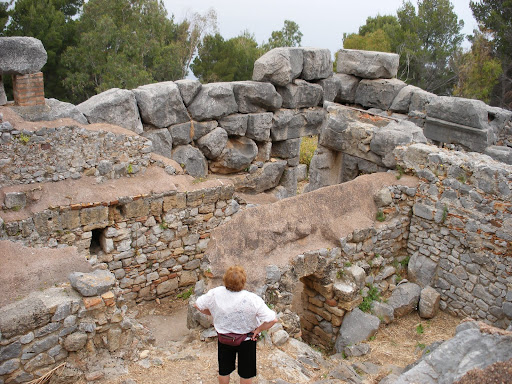
The Sicanians are thought to be the earliest inhabitants of the island of Sicily, perhaps the indigenous people. Because I am feeling terribly lazy tonight, I'm linking to an interesting article on the Sicanians in case you want to get up to speed on them. I'm in a cut-to-the-chase mood. The picture on their site is one included below. It's called The Temple of Diana.

"The temple a megalithic building dating back to the IX century B.C., is the only pre-classical monument in Sicily."
IgoUgo Photo: "Temple of Diana" in Sicily by Dreverhttp://www.italianvisits.com/images/sicily-im/cefalu/cefalu-temple_of_diana.jpg.


http://lh4.ggpht.com/_nDtXxE0nu2U/SDSINwDkpmI/AAAAAAAABXM/tuxHuZmMQZE/338%20-%20cefalu%20-%20climb%20to%20la%20rocca%20-%20temple%20of%20diana.JPG.
There are Temples of Diana all over Sicily. This one is in Cefula. Segesta, Agregento, and other locations also have Temples of Diana, but the one pictured is the oldest. Segesta was also an ancient, possibly indigenous city tho the name might not be.

The inspiration for tonight's post are the neolithic carvings found in a cave on the northeast side of Mount Pellegrino.

Grotta dell'Addaura is a complex of caves in which bones and hunting tools and the general presence of Paleolithic peoples have been discovered. After Sicily was invaded in WWII, ammo was stored in the caves. "ohnoes!" I thought! "It will explode the drawings!" Some of the ammo "accidentally" went off and happened to blast away just enough to reveal the carvings which had been covered up by grime and time. The carvings are notable, for starters, because the focus is on people with a few animals in the "background" and because the people are shown in movement. Here is a picture:


http://grotteaddaura.interfree.it/immagini/grotta_addaura/b_grotta_addaura_completo.jpg
I intentionally left it large so you could look at the detail and play along at home.

What do you notice in this picture?


To me it appears to be a circle of people dancing around 2 figures who are on the ground.
There are figures with what look like beards.
The figure at the top right looks like it has a bird head.
The figure below the pair on the ground looks like a woman to me.
There is a deer below her.

The carvings date to 8,000 BCE.

The earliest known cave paintings were thought to be in France. In the past decade they lost the crown. Paintings found in the Fumane cave in Verona date back about 42,000 years. Is that about 10k years older than the french cave? And they weren't just flint scribbles either. They were paintings. With red and yellow ochre found there as well. I've always said Italians are the best artists ;)

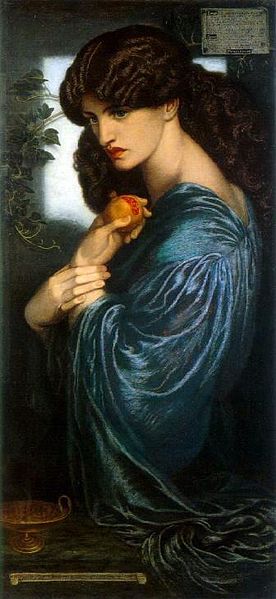
Proserpine, by Dante Gabriel Rossetti
File:Dante Gabriel Rossetti - Proserpine.JPG