Showing posts with label Proserpina. Show all posts

Wednesday, February 1, 2012

You call it Imbolc. We call it Februarius.

There are so many feasts and festivals upcoming and ongoing depending on the region, especially from pre-Roman times. Today we celebrate the return of Proserpine, or Kore to Her Mother and the upper world. To this day Catholics celebrate by lighting candles to the Queen of Heaven and blessing the candles. Celts celebrate Brigid/Imbolc. The Norse celebrate Freya.

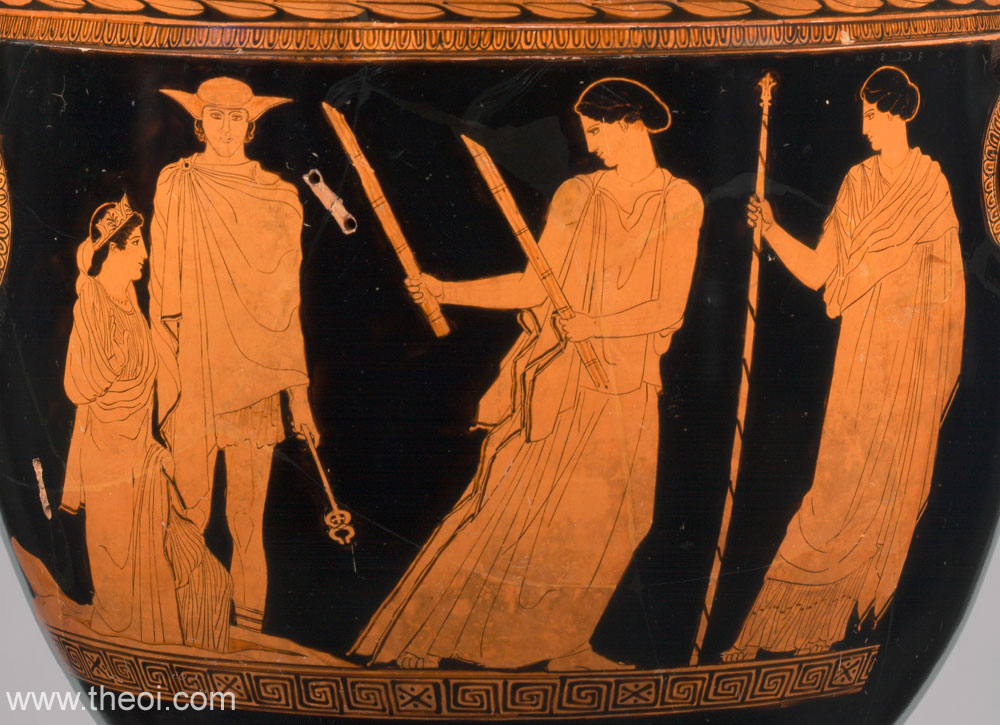
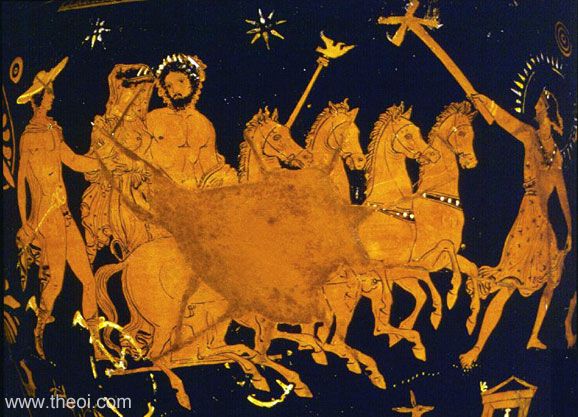
Return of Persephone, with Hades, Hermes & Hecate | Greek vase, Apulian red figure krater
The Return of Persephone
February is named for Februus, a possible Etruscan deity of purification and of the underworld. Perhaps an epithet of or akin to Pluto? I've seen the names Februa and Februatio in my studies as possible Sabine deities. Are they a Sabine divine pair who jointly ascend? The picture above shows Proserpine being returned to the upper world b Pluto and flanked by Hermes and Hecate.

This is the month of purification, of spring cleaning in preparation for the new year. Soon I'll be posting about the Parentalia (the origin of many hallow's eve traditions), Lupercalia and the origins of love day (my annual whip my Roman Sex Gods re-post with additional info!), Februalia, and the Feralia, celebrating the underworld deities (see what I mean about Februa and Februato?).

Whatever name you call this turn of the wheel, I hope you have a happy one!

Wednesday, November 16, 2011

Hekate's Night

Goddess Hecate of the triple road
Protect my family and abode
Lead me through darkest night
Grace my journey with your light
Saffron clad with serpent coils
Bring fruition to my toils
As canines bark and silence rend
Your holy feast I will attend
Garlic, poppies, sweets and grain
Tonight with you I'll dance again. 
-SoD original


A few words I was inspired to write now for Hecate's night. She is described as "saffron cloaked" which always made me think of the sun and how She is seen with Apollo in the typical tale of the Eleusinian Mysteries. I nearly smacked my head and said "duh!" when I realized that saffron is sacred to Mercury, with whom I believe She is a divine pair. He is the essence of Saffron and She is Saffron cloaked? Sounds like a euphemism! Also, the two appear together in the same tale as the Psychopomps who return Persephone to Demeter.

I'm off to celebrate Her tonight!

Now it is the time of night
That the graves all gaping wide,
Every one lets forth his sprite,
In the church-way paths to glide:
And we fairies, that do run
By the triple Hecate's team,
From the presence of the sun,
Following darkness like a dream,
Now are frolic: not a mouse
Shall disturb this hallow'd house:
I am sent with broom before,
To sweep the dust behind the door.
- A Midsummer Night's Dream

Friday, September 23, 2011

Happy Autumnalia!

I don't know if "autumnalia" is an actual word or if I just made it up. Who cares? "Mabon" is a made up name too, so let's just roll with it.

Tonight I did a simple ritual, nothing pre planned, all from the heart. I made offerings and petitions, and told the story of this time of the year. However, tonight's rendition was a bit different than in times past. I used to romanticize the abduction of Persephone and Demeter's lament, and the wine and grain festivals and a young girl becoming Woman and Queen. Then I grew up, gained some perspective, and did some research.

Also, with what I now understand of this holiday as a time of parthenogenetic Goddess worship and the passing of knowledge, lore and magic from mother to daughter, woman to woman in a community of women, I just get angry. Now I see my once romanticized mystery for what it is- not just an abduction of a daughter, but the abduction of a way of life and a culture. These Mysteries were taken from Sicily to male dominated Athens exactly the same way Persephone was taken from Demeter, and that just frosts my cookies. On top of that, so many people go around calling it "Mabon" that if I rolled my eyes any harder they'd shoot laser beams. Why the rolling?

Well, let's stick some more Male mythology on top of it all, shall we?

For some, this is about a son, Mabon, being taken from his Mother and rescued by King Arthur. So why is it about the son and not the Mother? It's Her lament! And she is given back what she lost by a man. Just sayin. Modron is typically syncretized with Demeter too. Interesting.

Then we have the perpetual battle of the Holly King and Oak King, with one vanquishing the other through the year. All male all the time.

Don't get me wrong, I adore men and am having a red hot love affair with Mercury. But as this is the supposed to be the time of balance (the sun is even in Libra now- the literal sign of balance!), I have to ask: Where is the balance in all of these celebrations?

There is the matriarchal focus which I mentioned earlier, and others who unwittingly celebrate this holiday from an entirely patriarchal point of view. Is there ever any actual balance involved here?

After the Eleusinian Mysteries had concluded, there was a festival of Demeter and Apollo. These two are not often associated with each other. Don't you think they would be? In aspect as Mother Earth and Father Sky? If there is no sun, there is no grain. Apollo is mentioned along with Hekate in the lore of Eleusis, but only in passing (Hekate was hanging out with Apollo in the sky and they saw what had happened to Persephone). So how were Demeter and Apollo celebrated together? Were they? Anything about Demeter having a connection with male deities is either Zeus or Poseidon and remotely, Dionysus. However! There still stands the ruins of a temple dedicated to Demeter and Apollo as a pair on the island of Naxos:


This has been a lot of Greek talk tonight- so what did Italians do? Eat. Drink. Make offerings of bread and wine and fruit. Prep for the winter. There's no time to be high falutin when you're concerned with survival!
No matter which way you look at it, this is not the happiest time of year, a time to bid adieu to the blooming earth for a while, knowing that She will be restored. No wonder so many Pagans skip this holiday or just gloss over it!

No matter how you celebrate, no matter what you call it, I hope you have a good one :)

Wednesday, July 27, 2011

Streghe video summary

Luce di Strega is a Streghe summary video. I find it to be a proud piece for all of us of the blood. I know Beth finds it a bit tedious due to the many flashing images, but if you can get past that aspect, I think there is still quite some value to any followers of Stregheria. Especially to some of the newer folk just beginning your journey.

The background music is by German composer Carl Orff in which he took a medieval Latin poem written in the early 13th century named: "O Fortuna". It is part of the collection known as the Carmina Burana. It is a complaint about fate, and the Roman Goddess Fortuna. I also have an awesome video of "O Fortuna" which I would glady post if anyone is interested.

I truly hope that at least some of you enjoy this short journey.

Blessings all around,
Dusio

Sunday, July 24, 2011

Poetic interlude

I adore Edna St. Vincent Millay. She has written some of my favorite poetry ever and tonight I'm sharing a few, just because we need a poetic interlude. It's been a while since the last one! Her poems also reference Persephone, ancient temples, bergamot, rosemary, Euclid, The Muses, and others.

An Ancient Gesture
I thought, as I wiped my eyes on the corner of my apron:
Penelope did this too.
And more than once: you can't keep weaving all day
And undoing it all through the night;
Your arms get tired, and the back of your neck gets tight;
And along towards morning, when you think it will never be light,
And your husband has been gone, and you don't know where, for years.
Suddenly you burst into tears;
There is simply nothing else to do.

And I thought, as I wiped my eyes on the corner of my apron:
This is an ancient gesture, authentic, antique,
In the very best tradition, classic, Greek;
Ulysses did this too.
But only as a gesture,—a gesture which implied
To the assembled throng that he was much too moved to speak.
He learned it from Penelope...
Penelope, who really cried.

Daphne
Why do you follow me?—
Any moment I can be
Nothing but a laurel-tree.

Any moment of the chase
I can leave you in my place
A pink bough for your embrace.

Yet if over hill and hollow
Still it is your will to follow,
I am off;—to heel, Apollo!    

Witch-Wife
She is neither pink nor pale,
And she never will be all mine;
She learned her hands in a fairy-tale,
And her mouth on a valentine.

She has more hair than she needs;
In the sun 'tis a woe to me!
And her voice is a string of coloured beads,
Or steps leading into the sea.

She loves me all that she can,
And her ways to my ways resign;
But she was not made for any man,
And she never will be all mine.


Not with libations, but with shouts and laughter
We drenched the altars of Love's sacred grove,
Shaking to earth green fruits, impatient after
The launching of the colored moths of Love.
Love's proper myrtle and his mother's zone
We bound about our irreligious brows,
And fettered him with garlands of our own,
And spread a banquet in his frugal house.
Not yet the god has spoken; but I fear
Though we should break our bodies in his flame,
And pour our blood upon his altar, here
Henceforward is a grove without a name,
A pasture to the shaggy goats of Pan,
Whence flee forever a woman and a man. 


Here is my favorite poem of hers, which isn't very "Pagan" tho I suppose being a feminist during that era was pretty darn Pagan:

Oh, oh, you will be sorry for that word!

Oh, oh, you will be sorry for that word!
Give me back my book and take my kiss instead.
Was it my enemy or my friend I heard,
"What a big book for such a little head!"
Come, I will show you now my newest hat,
And you may watch me purse my mouth and prink!
Oh, I shall love you still, and all of that.
I never again shall tell you what I think.
I shall be sweet and crafty, soft and sly;
You will not catch me reading any more:
I shall be called a wife to pattern by;
And some day when you knock and push the door,
Some sane day, not too bright and not too stormy,
I shall be gone, and you may whistle for me. 
Tuesday, July 19, 2011

The Tragic Women of the Greco-Roman world...

I hate the term Greco-Roman, but alas, that pretty much describes what we have here. Tonight, Nemesis and I were talking about Dido's lament (aka her suicide speech). I remarked about that being the moment opera was born. We waxed poetic once again about Medea and Jason and how Medea has been much maligned over the years. This lead to a chat about Jeff Mach's play, Seeds, a bdsm take on the relationship between Hades and Persephone. I think fans of Ann Rice's The Claiming of Sleeping Beauty‎ will like it. It's slated to premiere at The Geeky Kink event in NJ, Nov 4th - 6th. This got me to thinking about all of the "wronged women" in Greek and Roman lore:

Ariadne: Abandoned by Theseus, "rescued" by Dionysus.
Demeter: Daughter stolen, gets to see her for half the year..
Hera: Cheated on left n right by Zeus.
Diana: Tricked into killing her lover, Orion!
Medussa: Get's it on with Neptune on Aphrodite's altar and is turned into a stone-turning, snake headed monster. And what happens to Neptune? Jack and shit. Nice.
Khione: Date-raped by two Gods, gives birth to their twins.
Helen: The face that launched a thousand ships. Nevermind that it was her husband who went after her when he could have just given her a divorce. Sheesh.
Pasiphaë: Minos' wife who winds up mating with a bull because Minos wouldn't sacrifice the best one to Neptune. That's where we got the minataur! She was an innocent bystander, yet she's the one who's blamed for doing it with a bull! And check out Neptune's involvement in yet another debasing of a Goddess... how did he come to be associated with these stories?
Athena: Hephaestus tries to rape her and his spunk lands on the earth which impregnates Gaia who then gives birth to Erichthonius!

I'm writing the Wronged Goddess version of the Vagina Monologues. What should I call it?

I don't take these stories literally, but I, and I'm sure many of you who bother to read this blog have looked beyond the surface of the stories and into the deeper themes. There is some evidence that Hephaestus and Athena were considered a divine pair and that Erichthonius is their son (Shhh! Don't tell Marguerite Rigoglioso!)

Likewise, Pasiphaë, Europa and Ariadne are linked with the Moon Goddess in ancient Crete, the theory being that "Ariadne" is a Greek epithet for the Goddess the same way "Lucina" is in Italy. I also like to note that Pasiphaë is the sister of Circe, Aunt of Medea and both are from Thessaly. I don't always appreciate wiki articles, but this one is a wonderful starting place. Note the mention of Pasiphaë as an oracular Goddess!


That's all for tonight. Tomorrow, something practical!

Friday, June 10, 2011

Busy Bee

That's what I am tonight! I'm writing up new classes, workshop proposals, details for a Datura Press fundraiser, updating NYC Pagan Pride info and reaching out to vendors, workshops, musicians and volunteers. I'm also working on the dedication of the labyrinth, and a New Moon ritual. Also working on  guest blog posts for other fabutastic blogs.


This link will download a pdf regarding the Eleusinian Mysteries and the Bee/honey. Interesting, basic article which sheds light on how closely related Demeter and her priestesses were to bees and honey. Marguerite Rigoglioso discusses how bees were a major symbol of all parthenogenic Goddesses including Diana. Speaking of MR... There is a podcast coming up next month with Marguerite Rigoglioso on Virgin Mother goddesses of Antiquity and specifically about Bees and their symbolism. I've just set a reminder for it! Can't wait!

Ancient historian, Pausanias, writes about the connection of Hermes and Honey in his Description of Greece :
"Each month the Eleans sacrifice once on all the altars I have enumerated. They sacrifice in an ancient manner; for they burn on the altars incense with wheat which has been kneaded with honey, placing also on the altars twigs of olive, and using wine for a libation . . . The traditional words spoken by them in the Town Hall at the libations, and the hymns which they sing, it were not right for me to introduce into my narrative. They pour libations, not only to the Greek gods, but also to the god [Zeus Ammon] in Libya, to Hera Ammonia and to Parammon (from Ammon), which is a surname of Hermes."
In the Homeric hymn, Hermes and Apollo are involved with the Thraiae or Bee Nymphs, pictured here, who have a connection to the Delphic Oracle. I started talking about this in my review of Cult of Divine Birth.

I've also been reading about how bees were treated and revered in ancient Sicily: They were considered members of the family! They were told the family news of the day, and offerings of cakes or food were left whenever there was a celebration... the same that is done for the Lare.

ok, busy bees, I'm off for the night!

Monday, June 6, 2011

The Heroine's Journey

I've been working a post about The Hero's Journey as illustrated by the lore of Proserpine and Demeter. However, you don't hear much about what happened once She descended. There are clues in the tale of Inanna, and a lot of talk about it lasting 3 days, during the dark of the moon, her ordeal, but most of what we have of Kore's tale involves the Greek Mysteries where Demeter is searching for her lost daughter. I think this whole thing is bunk and more about the relocation of the mysteries to Greece and the insertion of the Patriarchy into what began as Women's Mysteries. I also find it interesting that Hekate is associated with Ereshkigal, who appears as Queen of the Underworld and "older sister" of Inanna and eventually releases Inanna back to life, and Hekate escorts Proserpina back to the surface, in some portrayals it seems like Hekate is facilitating an escape.


  There is so much out there about The Hero's Journey, especially since Star Wars was modeled on the steps, that I don't really want to recap it here, so I've linked to the wiki basics. If you don't want to surf over, there's a fun graphic illustrating the trip there and back again:

ie: Luke Skywalker is called to adventure by Leia (hologram message on R2D2), he's aided by the droids, mentored by Obi Wan, it goes on and on. The Matrix follows the formula too as does The Lord of the Rings. Actually, most movies and legends follow this archetypal formula.


Back to my Goddesses: There isn't much written about Kore in the Underworld because it is the crux of Initiation itself: It's removing each earthly accoutrement, confronting your dark side/your shadow self and surrendering yourself to transformation. It's also so much more, and despite it being incredibly individualized, initiates, true initiates- not the ones who are socially promoted for reading 10 books and making an origami tree of life- will recognize each other. There is a knowing, an understanding that you come to that cannot be imparted to someone who has not been through it, and need not be imparted to someone who has. Mothers understand this. Motherhood is an initiation.

In the Descent of Inanna, we see the steps she goes through to get into the Underworld, but we still do not know where her essence was when she was "dead" for those three days. Where did her spirit go? Since she's in the Underworld why didn't she just appear there and haunt her sister? What did she face? What did she do? What did she see? Perhaps the same thing every initiate sees: what they need to.

I feel like I've been on my own journey tonight, examining the similarities between the descent of Inanna and the descent of Proserpine. Funny how I've known both of these epics in great detail for so long but have never put them side by side and compared. In the Greek version she's taken against her will, but as per the link above to the Women's Mysteries, I don't believe it. I'm of the school that, like Inanna, Proserpine went of her own accord to learn the Mysteries and return to Her people with knowledge thereof and her dual role as Goddess of Spring/birth/fertility and Winter/death/barren is because She, as Innana did, merged with Her Shadow self and returned the wiser for it.

However, we also have Ereshkigal, who is established as the Queen of the Underworld. Wouldn't she be the appropriate counterpart here? Are Proserpine and Demeter sisters instead of mother and child? Does it matter? What does the familial relationship imply?

All very interesting, but now that it's after 2 am, I'm going to sleep on it and I hope you do too. I hope you ponder The Mysteries and ask the questions and challenge your own perceptions.

Wednesday, March 16, 2011

Happy Irish Heritage Day

Argh, I want to post 10 other things right now, but instead I'm going to say what I've said every year for the past 2 decades:

Unless you're going to pitch as much of a fit over this day as the one in October, please STFU and let us Italians have a day of Pride in our heritage too. At least we don't get shit-faced at our parades. And the food is better. Rename them "Irish Heritage Day" and in October "Italian Heritage Day" and everyone can be happy. There, my rant is done.

Speaking of getting shit-faced, here is another entry in my ongoing series of saintly veneers put over Pagan celebrations: This week is the Bacchinalia, the festival of Bacchus! Time to drink and dance. No wonder it's a tradition to get drunk at this time of year! After this long-ass Winter I'm ready to tie one on for the start of Spring too!

The Bacchanalia were wild and mystic festivals of the Roman god Bacchus. Introduced into Rome from lower Italy by way of Etruria (c. 200 BC), the bacchanalia were originally held in secret and attended by women only. The festivals occurred on three days of the year in the grove of Simila near the Aventine Hill, on March 16 and March 17.

Wiki has a lengthy article on this which is actually worth reading. It touches on Crete as a wine source, and a center of the mysteries. Here is where Ariadne enters the picture. Funny, I just started following another blog that discusses Crete, Ariadne and the labyrinth (I found it while looking for Minoan labyrinth and Ariadne resources). So thanks to Debra for sharing more of Ariadne's story. I happen to agree that much of Greek mythology is the patriarchalization of earlier mysteries. Did I just make up a word? Awesome!

What was involved in a Bacchinalia? Did True Blood get it right? Wine and drugs and sex (and shape shifter sacrifice and a gigantic egg)? Sounds like a rave. Bacchinalias were the first raves! \o/ lol I don't drink, so I don't know why this appeals to me. Perhaps because my name is of Thracian origin and so are these mysteries? There is also a record of trance dancing and possession by Deity.

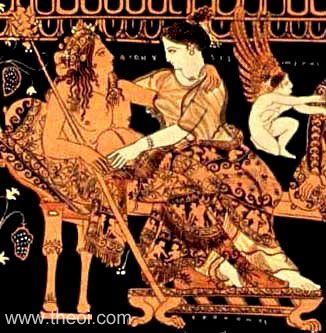
Dionysus/Bacchus absorbed many other deities including Liber and Zagreus. Absorbed or are they different aspects thereof? Anyway, a bit about Ariadne: Her name means "Most Holy" in both Greek and Latin. Quoth Wiki: Ariadne (Etruscan Areatha) is paired with Dionysus (Etruscan Fufluns) on engraved bronze Etruscan bronze mirrorbacks, where the Athenian culture-hero Theseus is absent, and Semele (Etruscan Semla), as mother of Dionysus, may accompany the pair, lending a particularly Etruscan air of family authority.

An inscription from Knossos (home of Ariadne, the infamous labyrinth and Minotaur) says: "to all the gods, honey... to the mistress of the labyrinth honey" Ariadne as Priestess of Knossos? Mistress of the Labyrinth? There are stories associating Dionysus and Proserpina. Is Ariadne another name for her? Certainly, if the labyrinth is the decent into and return from the Underworld, the labyrinth is her domain. Are the two Goddesses the same? Different names from different lands? Is Ariadne the Minoan Snake Goddess Herself? There are also myths involving Dionysus descending into the Underworld to retrieve Ariadne as well as his mother, Semele (Proserpina and Ceres?) It was spoofed in ancient times, by Aristophanes in his comedy, The Frogs. Instead of going to the underworld to get the women back, he complains about a lack of good writers and goes to bring back the best one. There is a contest where he decides. Stephen Sondheim updated the concept in a musical.

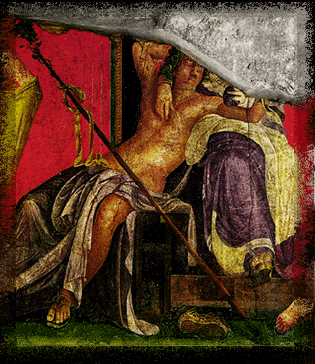
Note the last picture from the Villa of the Mysteries. Is this the Bacchic Cult Rites? Is it the Eleusinian Mysteries? Were they combined in Greece? Are Proserpina and Ariadne alternate names for the same Goddess? Mmmm food for thought, tastes great, less filling.


http://images.travelpod.com/tw_slides/ta00/bba/ce4/minoan-snake-goddess-palaiokhora.jpg


Dionysus & Ariadne at a tragedy play | Greek vase, Athenian red figure volute krater

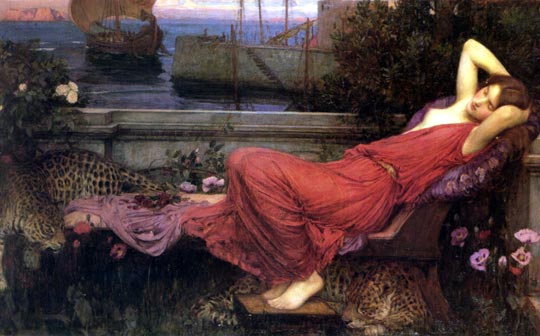
http://www.jwwaterhouse.com/paintings/images/waterhouse_ariadne.jpg
Note the Leopards in this Waterhouse painting. They are associated with Dionysus

Dionysus with Semele or Ariadne?


Wednesday, February 2, 2011

The earth, the air, the fire, the water: Return, return, return, return...

A quickie post: Today has been one where tiny pieces have fallen into place making the entire picture that much clearer. It's been a day of epiphanies and gnosis. What else would you expect on the cross-quarter new moon Proserpinalia? \o/

I give a favorite image from the lesser Eleusinian Mysteries:


http://www.theoi.com/image/T16.6Hekate.jpg

Mercury and Hekate and Ceres beginning Proserpina's return. Let's get on the road to Spring!

The day dawned dark and gray here, so I'm with the groundhog here in voting for Spring's immanent return! Maybe I'm just tired of the snow?

Tuesday, February 1, 2011

February! (feb-ROO-ary, not feb-YOU-ary)

Happy February!

Named for Februus. Sabine or Etruscan in origin, this deity is said to have been both ruler of the underworld and God of Purification. Makes sense when you think about it. The Romans liked him so much, they named a month for him. We're almost at the halfway point of winter. Time to start cleaning for Spring, aka Spring Cleaning! It's also a time for weather divination. I've always love the following poem for "groundhog day" because it explains why there are 6 more weeks of winter if the groundhog sees it's shadow: "If the day dawns fair and bright, Winter still has one more fight. If the day dawns dark and gray, winter's fight has gone it's way." I'm rooting for craptastic weather on Wednesday morning ;)

In the meantime, here are a few favorite cleansing techniques I use. They're very basic, but sometimes we need a reminder:

Magickal shower: After washing, take some time to let the water rush down and imagine any negativity washing down the drain. Slowly turn counter-clockwise if it helps you to get into the spirit. Romans used to end a bath by plunging into cold water. I don't recommend doing that before bed lol

House cleansing: Seriously, get the dirt and dust out. You don't need a fancy powder or wash, first you need to work on the mundane level. If you're still up for it, use basic florida water. I like to mix it with a homemade tincture of Rue.


Burn your preferred cleansing or smudging herbs, like sage or frankincense. Once you've covered the whole house, open the windows and picture the smoke carrying out the old and letting in the new. If it's cold in your clime, don't leave the windows open too long! When those scents are gone, fill your home with your favorite smell, be it roses, lemons, fresh baked cookies, or your favorite childhood meal.

Here is a wonderful quote regarding this month:
"The conception of the Virgin Mary is represented on the same day (the 2nd of February) as that of the miraculous conception of Juno by the ancient Romans. This, says the author of the Perennial Calendar, is a remarkable coincidence. [...] It is also a remarkable coincidence that the Romans should have had their Prosipernalia, or Feast of Candles or Candlemass in February [...] Thus we see that the Roman Catholics have been in the habit of celebrating Christian festivals upon days which were held sacred by the heathens." W. Winwoode Read, The Veil of Isis; or, The Mysteries of the Druids, 1861, 5.I.

I find it interesting that this is the only reference to it being the Prosipernalia. There is another reference to reenacting Ceres looking for her Daughter through the night using candles to search the dark, but I can't find the exact source right now. Where was she taken? Even the Greeks say it was in Sicily. Who is the Goddess of Sicily? Proserpina. The timing doesn't jive with her abduction, but the timing is perfect to anticipate her return and to start looking for her. Haven't you already seen signs? Today it was sunny here and I could smell Spring in the air. Proserpina is returning, and this search is a joyous one– not fraught with worry, but filled with hope.

My family celebrated the impending return of Spring Herself by burning old candles , making recipes which needed time to cure, spring cleaning and stocking up and preparing the votive candles used daily. We didn't call it Prosipernalia, but we did raise a glass and light a candle to The Goddess of Sicily.

Was Februus an earlier or Sabine version of Pluto? He was alleged to be ruler of the underworld. If so, veneration of Proserpina fits perfectly here.

Here's hoping for an early return of Spring!

Saturday, January 22, 2011

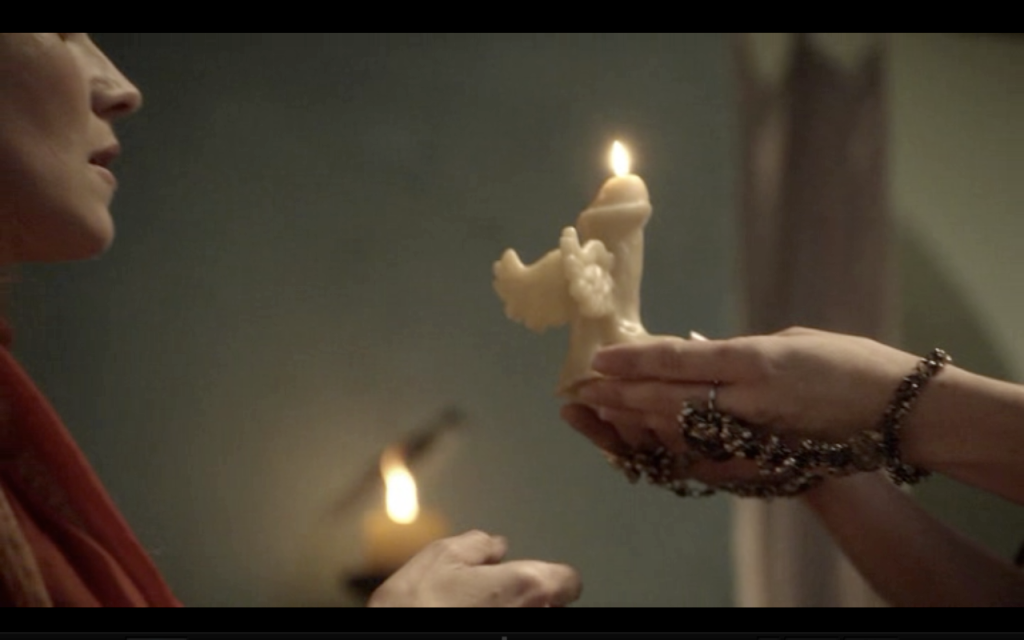
Where can I get a winged penis candle?

Seriously, it's just that fun to see. Well, until it starts melting, I bet. Eeew, never mind. I posted too quickly yesterday, Spartacus premieres tonight and I won't get to see it until tomorrow when it's available on Netflix. In the meanwhile, I've been going over information about fertility magic in Ancient Italy. Here are two Goddesses of Fertility who I find interesting: Diana and Juno Lucina. Why do these Goddesses interest me?

Diana is my Patroness. Forget about her being an anti-man "virgin" and disavowing men. The ones who disavowed men were Vestal Virgins. Vesta. Not Diana. "Virgin" didn't mean no sex. Nor did it mean not bearing children. It meant independent. In her lore, Diana had several consorts: Lucifer to her Lucina, Orion, Verbius and each subsequent Rex Nemorensis. Diana, as Goddess, was Kingmaker. There is a notion, in more than just greco-roman lore, that to see or hear deity in true form meant death to a mortal. A man, such as Acteon, seeing a Goddess "naked" (as in without the cover of human form), would have killed him. Another theory is that the ritual of the Rex Nemorensis involves Diana revealing herself to the new Rex. Since he is the chosen one, he survives it. Any man who saw her as such but was not the chosen one would be killed. Back to the fertility stuff: Diana was Goddess of the Moon. Which is tied to a woman's cycle, hence fertility. Weee!

Juno Lucina. Here's a Fun one. Both Juno and Diana were referred to as Lucina. There are references to Juno Lucina, and to Lucina being another name for Diana. Roman Religion and the Cult of Diana at Aricia has some interesting arguments about past theories, including the idea that Juno and Diana were the same Goddess and syncretized incorrectly. Hmm I don't know. There is the fun theory that Herodias, aka Aradia, is a combination of Hera and Diana. Pages 136 and 137 have some great info about the votives found at the sanctuary at Aricia: clay representations of babies and wombs. There is evidence that Juno was thought of as a Moon Goddess too. She was Juno at the Kalends, Juno Covella (crescent moon), and Juno Lucina at the full moon. Do we have another contender for Triple Goddess of the Moon?
Again, Italy was a land of diverse people and diverse languages. Different names meant different things to different people who lived next to each other. However, as there was a temple to her, and she was said to be the wife of Jupiter and has her own festival on March 1st, the Matronalia, I will give Juno her props as a separate Goddess.

There is a third favorite on my list, but I will save Proserpina for another day and her own separate post.

On to the practical!

Italian folklore says eating an apple a day keeps the doctor away, but also the midwife near. Apples were thought to increase fertility.

To get pregnant, an impassioned plea would be made to the Deity of choice, a clay votive made of a baby and/or the womb and perhaps an offering, a contract? Amongst all the defixiones (curse tablets) found some were about getting something good and not just messing with other people. Not many tho. At least not of the ones found (the most were found in Sicily haha). Anyway, the principle is there: Petitioning Deity, making an offering, eating traditional foods associated with fertility. A fun Italian one is: Pesto sauce.
Whaaaaaat? Basil, olive oil, garlic and pine nuts were each thought to aid fertility. There has been some controversy recently about basil because it lowers estrogen levels. However, too much estrogen is as bad an impediment to fertility as is not enough. I was on the too much estrogen side of the equation and it interfered with my cycle. Pesto would've been my pal! I did, however, eat a lot of tomato and basil! Lycopene is thought to boost fertility too ;)

And if you missed it last night:

Sunday, January 9, 2011

Triskele

Sicilians use the 3-legged symbol on their flag. So do the Manx, on the flag of the Isle of Mann. The Sicilian Triskele is unique for including the head of a woman at it's center whereas other ones are just legs joined at the hip.

So who used it first? There is evidence to support both arguments:
• There are neolithic stone carvings in spiral form near Newgrange.
• Triskele/Triskelion come from the Greek word for 3-legged.
• There are Greek vases with the symbol on it, tho minus the woman's head.
• Celts lived in what became Northern Italy, but that's a far cry from Sicily, which had a history separate from and in addition to Italy proper.
• Greeks used the emblem on coins and ships.
• Pliny claims it was based on the shape of Sicily, whose 3 points are equidistant.

I believe the woman's head is a Goddess, worshiped at Lake Pergusa, which is in the exact center of the island and equidistant from the 3 capes. Proserpina (Persephone) is the Goddess of Sicily and is said to have been "abducted by Hades" from a lake in Enna. That's where Lake Pergusa is. The lake turns red at times over the summer. It has been called the Lake of Blood and was a gathering place for Women's Mysteries: "Lake Pergusa was once the location of an important religious center dedicated to female deities. Ceramic material found there dates to as early as 4000 BCE, and remains of circular and elliptical huts overlooking the lake date to 2500 BCE."-- Persephone's Sacred Lake and the Ancient Female Mystery Religion in the Womb of Sicily, Marguerite Rigoglioso.

Click above to download the article- it's fabulous. It confirmed nearly everything I felt was true about the Elusinian Mysteries, which has been added to the list of blog topics. Maybe I'll get around to posting about that this summer, 13 years since my visit to Eleusis.)

In the realm of historical research and who had more influence on whom, the vast expanse of trade and travel and conquering and wars has my head in a tizzy. I need to audit some classes on the warfare of the ancient greeks, romans and celts. Combine the wars, the colonizations, and the trade routes and it's a bit overwhelming. I need a guide who can help me take it in one logical piece at a time instead of trying to inhale it whole. I need a guide through this labyrinth.

Perhaps it's just one of those ancient archetypes ingrained in us all.