Showing posts with label Juno Lucina. Show all posts

Wednesday, December 14, 2011

The real Santa of the season: Santa Lucia!

Santa Lucia, thy light is glowing
Through darkest winter night, comfort is bestowing.
Dreams float on dreams tonight,
Santa Lucia, Santa Lucia

Lucia, or Lucina, is an epithet of the Goddess, used in reference to both Diana and Juno. She protected the people of Sicily. Her "origin" is in Syracuse, part of Sicily and the territory known as Magna Graecia. She is the Goddess of birth and of light. I mentioned this somewhere in my rant last night:

Santa Lucia, allegedly an early church martyr, but previously celebrated as the Goddess who midwifes the about-to-be-reborn sun into the world. The feast is a reminder that it is She who guides us through the darkness with her flaming crown of stars.

I was reminded of the following during my meditations today: Beyond the role of "midwife" or Patroness of pregnant women and childbirth, She is The Starry Night personified. She isn't just our guide through the darkness, she IS the darkness, she IS night. She is the one dividing herself and giving birth.

The Goddess Lucia is about bringing forth into the light- she brings children into the light, she brings The Sun into being and therefore brings all of us into the light. We can now see because of Her efforts. The Saint Lucy story which developed is about a young woman whose eyes were cut out when she wouldn't renounce christianity. Love how the sight thing still plays into it. I also love (in that sarcastic kind of way) that the continued tradition of a young woman wearing a crown of candles was written into the new version as how she protected people. Really? By wearing dripping flaming candles on your head? Right.

I think it's lovely that Her fest begins 12 days before Dies Natalis Solis Invicti. It's the 12 days of ;) She is the "Bringer of Light" and the patron saint of vision, including psychic vision. This is an excellent night for divination!


Here is a song sung as part of a modern catholic celebration. Quite the Pagan ditty:


Hark! through the darksome night
Sounds come a winging:
Lo! 'tis the Queen of Light
Joyfully singing.
Welcome thou vision rare,
Lights glowing in thy hair.
Santa Lucia, Santa Lucia!
Santa Lucia,
Thy light is glowing
Through darkest winter night,
Comfort bestowing.
Dreams float on dreams tonight,
Comes then the morning light,
Santa Lucia, Santa Lucia.
Deep in the northern sky
Bright stars are beaming;
Christmas is drawing nigh
Candles are gleaming (Repeat x6)
Clad i n her garment white,
Wearing her crown of light,
Santa Lucia, Santa Lucia. (Repeat)

Wiki has some nifty information on midwinter Goddess centered celebrations which all seem to tie together in the figure of Santa Lucia. Is this another case of Mother Goddess celebration or sites being taken over by male cults? More to ponder!


Until tomorrow, Loyal Horde! Blessings of Lucia on you: May your vision be clear, may your vision be true. Blessings of light in darkest night!

Thursday, July 14, 2011

Bunnies! (Not the fluffy kind. Well, fluffy, but not the mcwiccan kind!)

When I told Dusio that I was at a loss for post topic, he suggested I post about one of my "totem" animals. After some debate, I decided to share: I've always felt a connection to the hare, even as a young child, including making them my kindergarten project and learning to draw and create them out of clay. Always loved em. And wen I moved out here, saw them all the time. I still do, when I'm quietly walking my land and in the moment.

I remember looking them up in Animal-Speak by Ted Andrews a few years ago and just shaking my head, laughing at how I had more in common with them than not. I'm a herbivore, as are our rabbit friends, was born in the year of the rabbit, and my patrons are linked to the hare, all of which are linked to the moon: baby bunnies are ready to be on their own after 28 days.

According to Stories rabbits tell: a natural and cultural history of a misunderstood creature by By Susan E. Davis and Margo DeMello:

The Egyptian word for hare is "Un" or "open/open to/the opener." Hares were considered sacred to the Goddess Diana in her aspect as Lucina. In Sanskrit, the word for moon "cacadharas" means "one who carries the hare.

Mercury is added to the rabbit lore mix by virtue of his virility: A legend I've remarked on in the past: Both Apollo and Mercury wanted Khione. Apollo seduced her and she became pregnant. Later that night, Mercury did the same. And also impregnated her. The rabbit has the wonderful distinction of being able to become pregnant when it's already in the middle of a pregnancy!

Thanks to theoi.com:
Pseudo-Hyginus, Astronomica 2. 33 (trans. Grant) (Roman mythographer C2nd A.D.) :
"Hare [constellation Lepus]. Some say that it was put there by Mercurius, and that it had been given the faculty, beyond other kinds of quadrapeds, of being pregnant with new offspring when giving birth to others."

Rabbits aren't nocturnal, but crepuscular: they're out and about during twilight. Because of this and their ability to create tunnels underground, they're associated with Fairies and the Underworld. Down the rabbit hole, anyone? ;)

The rabbit is also known as a trickster, like some God we know? ;) Back to our friends with the bunny book. They talk about how women and rabbits are closely linked, and not just in Goddess imagery:


The word "cunning" is derived from the Latin for the word "to know," cunnan, which is related to the word for rabbit, or cuniculus. From here we can leap to the english "coney" or "dupe/one who is fooled." The When the pronunciation rhymes with "honey" it becomes slang for vulva. They way they tell it, the pronunciation of "Coney Island" was changed to suit Victorian sensibilities.

The rabbit is still linked to fertility. Here's a link to the Snopes article on the origin of the phrase "the rabbit died." Oh great, now I've got Aerosmith stuck in my head!

I'm behind a night on posting. Tonight starts the Feast of Demeter, translated into the Feast of Our Lady of Mt. Carmel. Over the next few days I hope to post info on both the ancient and modern feast!

Monday, January 24, 2011

Fertility God of Rome

Did you expect a part 2 from yesterday? Nah, not immediately. Soon? But for tonight let's talk about the main fertility god of Rome.

This fertility deity was the most widely worshiped God in Rome. He had many names, had 4 festivals in the first month of the Roman year and even has a day named after him. He predates Rome. He fathered Rome. Who else could I possibly be talking about but Mars.

The God of War was first a God of Fertility. He was the father of Romulus and Remus, lover of Love Herself, and the one called on in war. He is Gradivus, the strider, who precedes an army into battle. He is also the Avenger and the Protector. Before Rome, and his syncretization with the Greek Ares, Mars was a cthonic deity of Spring. His festivals are in March, he is called on to protect the herds of cattle and to fertilize the land. There ware ancient offerings to Mars Silvanus ("of the woods"). Check out our friends at Nova Roma for the text of the offering.

Who were his parents? Juno. Dad? I said Juno. Funny how she's been mentioned in posts this week. I need to stop writing at night because I'm tired and forget things more easily. Something was nagging me about why Juno was a Goddess of childbirth. Not just in general either. She was a Goddess of women for whom childbirth seemed impossible. It started with Minerva. Legend has it that Minerva sprang fully formed from the head of Jupiter. Wisdom and creativity personified. Think Juno would let that pass without evening the score? Not with her reputation.

Legend has it that Juno consulted the Goddess Flora about the matter. Flora plucked a specific flower and used to to impregnate Juno. The result was Mars. Born of the union of a Woman and a flower. Of course he was an earthy deity of fertility!

I want to keep going, especially since his animal was the wolf, but I must leave it for another post! I'll close with the following since we're talking about fertility deities: Happy Sementivae!

Sementivae, also known as Feriae Sementivae, is a Roman festival of sowing.  It is held in honor of Ceres (the goddess of agriculture) and Tellus (Mother Earth). The initial half of the event is a festival in honor of Tellus which runs from January 24 through January 26. The festival honoring Ceres occurs one week later, starting February 2. (From our friends at pagancalendar.co.uk)

Saturday, January 22, 2011

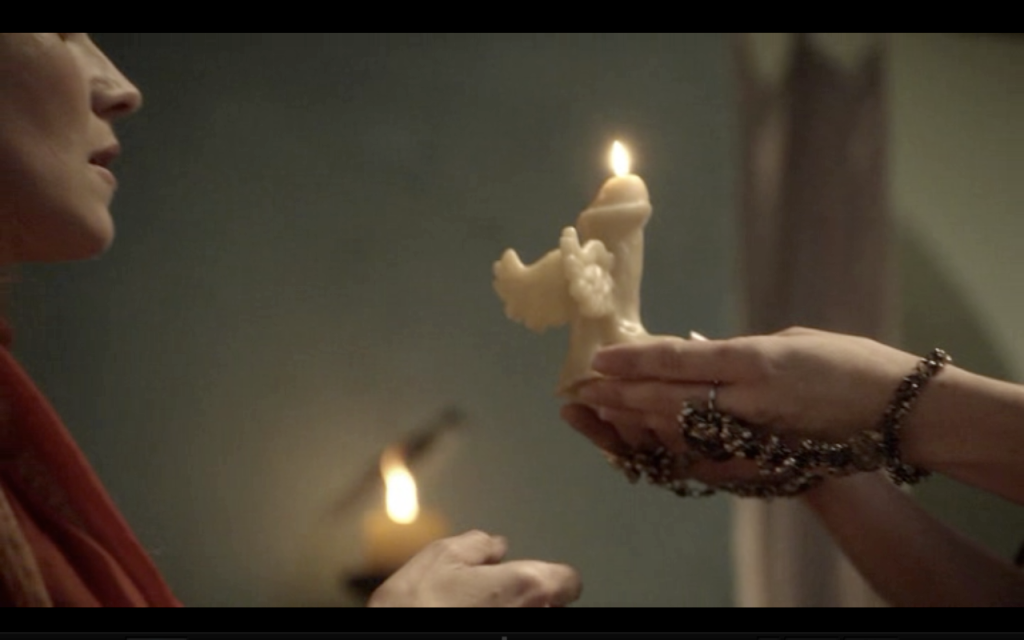
Where can I get a winged penis candle?

Seriously, it's just that fun to see. Well, until it starts melting, I bet. Eeew, never mind. I posted too quickly yesterday, Spartacus premieres tonight and I won't get to see it until tomorrow when it's available on Netflix. In the meanwhile, I've been going over information about fertility magic in Ancient Italy. Here are two Goddesses of Fertility who I find interesting: Diana and Juno Lucina. Why do these Goddesses interest me?

Diana is my Patroness. Forget about her being an anti-man "virgin" and disavowing men. The ones who disavowed men were Vestal Virgins. Vesta. Not Diana. "Virgin" didn't mean no sex. Nor did it mean not bearing children. It meant independent. In her lore, Diana had several consorts: Lucifer to her Lucina, Orion, Verbius and each subsequent Rex Nemorensis. Diana, as Goddess, was Kingmaker. There is a notion, in more than just greco-roman lore, that to see or hear deity in true form meant death to a mortal. A man, such as Acteon, seeing a Goddess "naked" (as in without the cover of human form), would have killed him. Another theory is that the ritual of the Rex Nemorensis involves Diana revealing herself to the new Rex. Since he is the chosen one, he survives it. Any man who saw her as such but was not the chosen one would be killed. Back to the fertility stuff: Diana was Goddess of the Moon. Which is tied to a woman's cycle, hence fertility. Weee!

Juno Lucina. Here's a Fun one. Both Juno and Diana were referred to as Lucina. There are references to Juno Lucina, and to Lucina being another name for Diana. Roman Religion and the Cult of Diana at Aricia has some interesting arguments about past theories, including the idea that Juno and Diana were the same Goddess and syncretized incorrectly. Hmm I don't know. There is the fun theory that Herodias, aka Aradia, is a combination of Hera and Diana. Pages 136 and 137 have some great info about the votives found at the sanctuary at Aricia: clay representations of babies and wombs. There is evidence that Juno was thought of as a Moon Goddess too. She was Juno at the Kalends, Juno Covella (crescent moon), and Juno Lucina at the full moon. Do we have another contender for Triple Goddess of the Moon?
Again, Italy was a land of diverse people and diverse languages. Different names meant different things to different people who lived next to each other. However, as there was a temple to her, and she was said to be the wife of Jupiter and has her own festival on March 1st, the Matronalia, I will give Juno her props as a separate Goddess.

There is a third favorite on my list, but I will save Proserpina for another day and her own separate post.

On to the practical!

Italian folklore says eating an apple a day keeps the doctor away, but also the midwife near. Apples were thought to increase fertility.

To get pregnant, an impassioned plea would be made to the Deity of choice, a clay votive made of a baby and/or the womb and perhaps an offering, a contract? Amongst all the defixiones (curse tablets) found some were about getting something good and not just messing with other people. Not many tho. At least not of the ones found (the most were found in Sicily haha). Anyway, the principle is there: Petitioning Deity, making an offering, eating traditional foods associated with fertility. A fun Italian one is: Pesto sauce.
Whaaaaaat? Basil, olive oil, garlic and pine nuts were each thought to aid fertility. There has been some controversy recently about basil because it lowers estrogen levels. However, too much estrogen is as bad an impediment to fertility as is not enough. I was on the too much estrogen side of the equation and it interfered with my cycle. Pesto would've been my pal! I did, however, eat a lot of tomato and basil! Lycopene is thought to boost fertility too ;)

And if you missed it last night: